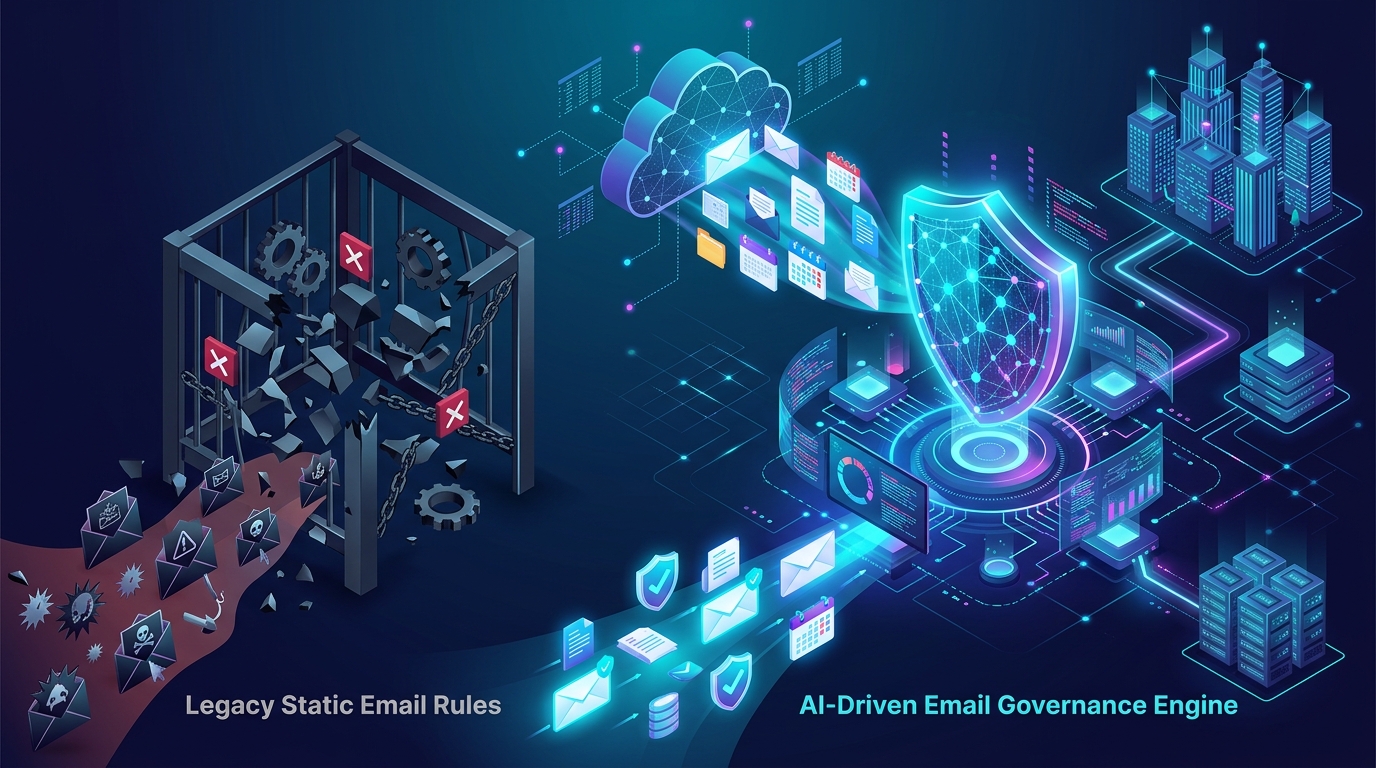
Email rules written years ago fail because the enterprise operating environment changed while static rules did not:
- Perimeter dissolution: Cloud collaboration, remote work, personal-device forwarding, and shadow IT bypass rigid boundary filters.
- Automated content processing: AI writing assistants and email plug-ins generate dynamic message patterns keyword lists never anticipated.
- Contextual blind spots: Static keyword rules cannot evaluate intent, sender-recipient relationships, or conversation threads.
- Context-aware governance: Replaces brittle rule lists with adaptive, semantic policies that log every enforcement decision for audit.
This eliminates rule drift and ensures that enterprise compliance policies remain defensible as communication patterns evolve.
⚡ Key Takeaways
- Email rules do not expire automatically: They keep running quietly long after the risk or business model they were built for has changed.
- Rule drift is the real enemy: Overlapping, conflicting, and orphaned rules create unpredictable mail flow that administrators fear to touch.
- Static rules match patterns; modern risk depends on context: Effective protection requires knowing who is sending what, to whom, and why.
- AI-driven governance must remain defensible: Contextual AI only succeeds when its decisions are transparent, explainable, and auditable.
- The goal is modernization, not total replacement: Audit existing rules, retire stale logic, keep high-confidence blocks, and let AI handle nuanced context.
Why Email Rules Go Stale
Most enterprise email rules were conceived in response to a specific historic moment: an uncomfortable audit finding, an executive near-miss, a new compliance regulation, or an infrastructure migration. The engineer or compliance officer who authored the rule often left the organization years ago. The rule stayed.
Over time, four predictable decay dynamics take hold:
- The business outgrows the rules: New subsidiaries, regions, partner vendors, and data categories emerge, but mail flow rules continue enforcing the parameters of last decade's organization.
- Rules continuously accumulate without retirement: Every new incident prompts another transport rule or DLP filter. Few are ever deprecated, creating complex rule collisions, unpredictable priority ordering, and unexplained mail delays.
- Nobody owns or dares to edit them: Without designated owners or mandatory review dates, legacy rules become untouchable "dark architecture" for fear of breaking business-critical communications.
- Platform limits force risky compromises: Administrators hit tenant rule ceilings and combine unrelated regex expressions or delete legacy safeguards just to make space. See How to Bypass the 300 Transport Rule Limit in Exchange Online.
The consequence is a security posture that looks comprehensive on an executive checklist, but operates unpredictably and leaves massive blind spots in production.
What Has Changed Since Your Rules Were Written
Modern enterprise work environments bear little resemblance to the on-premise perimeter for which legacy email rules were originally designed:
These are not unusual anomalies—they are the standard daily conditions of contemporary business communication.
Where Static Rules Break Down in Practice
1. They match words, not meaning
A rule searching for specific 9-digit numbers or exact keywords cannot differentiate between an employee discussing a published whitepaper and an accidental disclosure of sensitive trade secrets. For a technical analysis of this limitation, see Why Basic Office 365 DLP Fails at Context (and How Semantic AI Fixes It).
2. They breed alert fatigue and exception proliferation
Because static rules lack nuance, they trigger high false-positive volumes. Frustrated users request exemptions, and administrators create exclusions that permanently weaken organizational defense.
3. They ignore sender-recipient context and conversational history
Sharing financial forecasts with an external auditing partner is completely legitimate; sharing that identical attachment with an unvetted vendor is a catastrophic breach. Static transport rules struggle to evaluate such contextual nuances.
4. They fail the defensibility test
When regulators or opposing legal counsel investigate why an unauthorized disclosure occurred, citing an unmaintained rule from 2018 does not constitute defensible oversight. See Email Audit Trail for Legal Hold: What 'Defensible' Actually Means.
5. They cannot adapt to emerging risks
Adapting to a novel threat requires writing a new rule, submitting IT change tickets, testing regex syntax, and waiting hours for global propagation. Modern governance demands instantaneous adaptation.
What AI-Driven Email Governance Does Differently
AI-driven email governance applies policy dynamically by evaluating the holistic context and intent of every communication:
- Semantic intelligence: Evaluates message bodies, attachments, and thread context to understand sensitivity rather than scanning for keyword strings.
- Contextual behavioral awareness: Weighs sender authority, recipient domain trust, historical interaction frequency, and anomaly indicators.
- Natural language policy enforcement: Compliance teams define intent-based rules (e.g., "Require approval before contract redlines are sent to unverified external domains") instead of tangled regex tables.
- Continuous model tuning: Incorporates reviewer approvals and overrides into an active feedback loop, continuously reducing false positives.
- Defensible audit logging: Every decision is recorded alongside its contextual justification, producing verifiable compliance evidence.
This expands beyond simple DLP detection into comprehensive lifecycle governance. For a detailed comparison, explore Outbound Email DLP vs Email Governance: What's the Difference? and our blueprint on Beyond Basic Transport Rules: Setting up Automated Mail Governance.
Static Rules vs. AI-Driven Governance: Side-by-Side Comparison
How to Audit the Email Rules You Already Have
Modernizing your mail flow does not require an immediate rip-and-replace. Follow this 6-step audit methodology:
- Comprehensive inventory: Export all Exchange Online transport rules, Purview DLP configurations, and mail connectors, recording original creation dates and authors.
- Establish explicit ownership: Designate an active business owner and mandatory quarterly review date for every rule. Orphaned rules should be quarantined for deprecation.
- Identify collisions and redundancy: Detect duplicate conditions, conflicting actions, and shadowed rules that never execute due to priority precedence.
- Audit against production traffic: Switch uncertain rules to "Test with Policy Tips" or audit-only mode to measure actual trigger rates and false positives.
- Map to active regulatory obligations: Correlate remaining rules against current compliance mandates. Retire any rule lacking a clear business or legal justification.
- Document structural gaps: Identify blind spots—such as autocomplete errors, look-alike domains, and thread shifts—that demand contextual intelligence.
For more architectural considerations during audit reviews, see Exchange Online Compliance Gaps Most IT Teams Don't Know They Have.
What to Evaluate Before Adopting AI-Driven Governance
Before selecting an intelligent governance platform, evaluate these technical benchmarks:
- Explainability: Does the platform provide the reasoning behind its decisions, or does it function as an opaque black box?
- Human-in-the-loop controls: Are there intuitive approval workflows allowing compliance teams to review borderline messages?
- Data privacy & residency: Ensure mail processing occurs within your approved sovereignty region with zero third-party AI training on your corporate data.
- Multi-environment support: Verify native support across Microsoft 365, Exchange Server on-premise, and Google Workspace. Read Exchange Server Integration Architecture.
- Retention & eDiscovery readiness: Confirm the platform supports immutable archiving and litigation holds. See Legal Hold & Defensible Recordkeeping.
- Platform comparison: Benchmark capabilities against current tooling. See Microsoft Purview Alternative: What to Look for in an Email Governance Platform and Top 12 AI-Powered Email Governance Tools.
A Practical Path: Audit, Retire, Then Add Context
Achieving modern email governance is a progressive evolution:
Audit & Retire
Eliminate obsolete, conflicting, and unowned rules to restore transparency and baseline performance to your mail flow.
Keep High-Confidence Rules
Retain deterministic rules for unambiguous requirements, such as blocking confirmed malicious domains and enforcing mandatory TLS encryption.
Add Semantic AI
Deploy AI classification to govern contextual scenarios—such as executive impersonation, shadow IT forwarding, and misdirected autocomplete slips.
Quarterly Oversight
Review automated actions, false-positive metrics, and policy overrides on a scheduled cadence to report audit evidence to compliance officers.
Frequently Asked Questions
Why do old email rules stop working?
Because corporate workflows, team structures, and threat vectors continually shift while static rules remain unchanged. Unchecked rules accumulate, create logic conflicts, and lose administrative ownership over time.
What is rule drift in email security?
Rule drift is the gradual decay of a security configuration: outdated conditions, overlapping policies, and unmanaged rules that no longer reflect actual organizational email behavior.
What is AI-driven email governance?
It is the application of natural language processing and contextual intelligence to enforce email policies based on meaning, relationship dynamics, and behavioral history, with immutable audit logging of every decision.
How is AI-driven governance different from DLP?
Traditional DLP inspects content for specific pattern matches to block or quarantine. Email governance encompasses the full communication lifecycle: classification, intelligent routing, role-based approvals, retention, and defensible auditability.
Does AI completely replace transport rules?
No. Binary requirements (like enforcing TLS or blocking known rogue domains) remain well-suited for static transport rules. AI adds contextual judgment where static rules cannot evaluate conversational intent.
How often should an enterprise review email rules?
At least quarterly for high-priority compliance and security policies, and immediately following major corporate events such as mergers, migrations, or regulatory updates.
Is AI-based email governance defensible in an audit?
Yes, provided the AI model produces clear decision rationales, supports human review and override, and logs every transaction in an immutable audit trail.
How do I know if my enterprise rules are outdated?
Common symptoms include high false-positive alert rates, rules with no designated owner or review date, rules that have never triggered in production logs, and security near-misses that completely bypassed existing filters.
Final Thoughts: Bridge the Governance Gap
The greatest threat posed by legacy email rules is not catastrophic immediate failure—it is the false sense of security they project while silently missing modern security and compliance exposures. Audit your existing rule baseline, decommission stale logic, and empower your organization with context-aware, explainable AI email governance.
Ready to see how intelligent email governance modernizes your mail flow? Book a technical demonstration with MailGovern today.