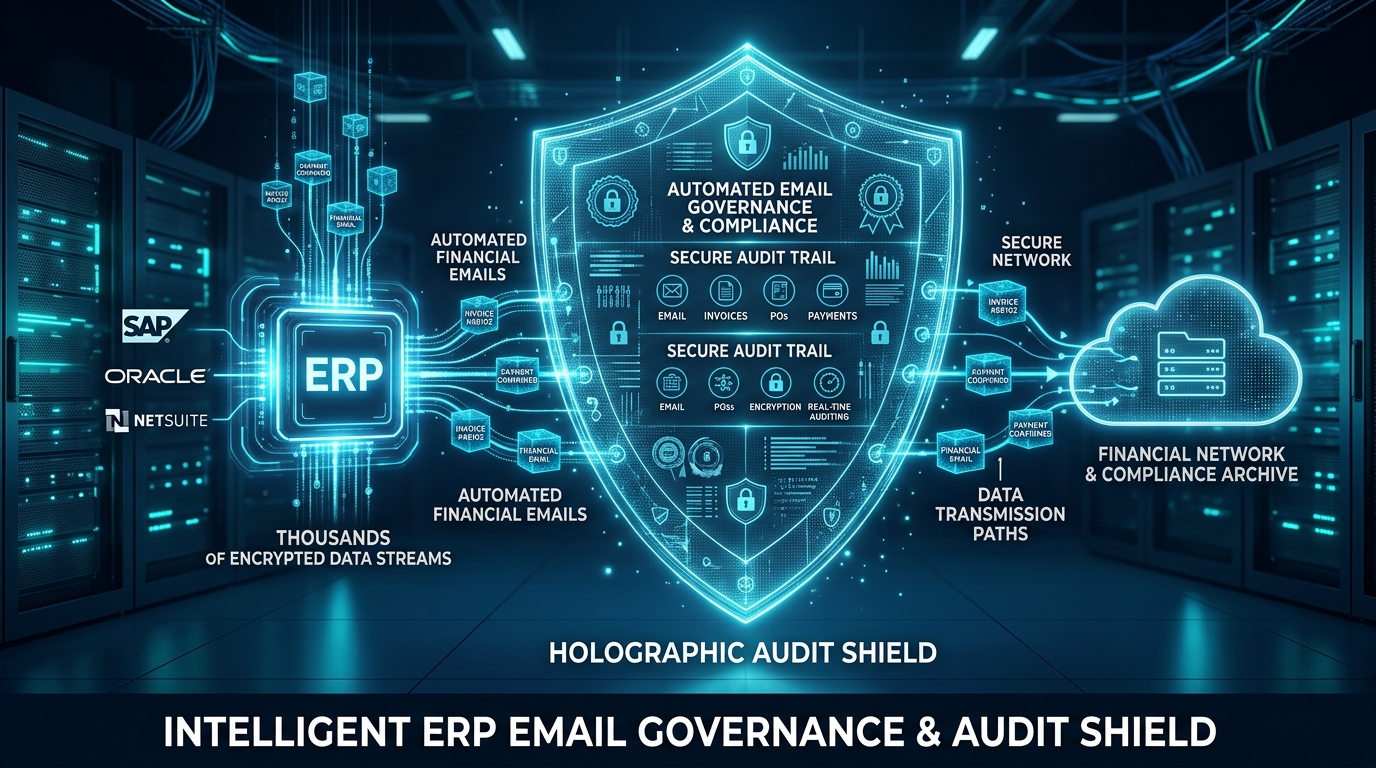
ERP systems generate and send some of the most sensitive email an organization produces: invoices, purchase orders, payment confirmations, payroll notices, and supplier bank details. Most ERP vendors secure the application itself, but not what happens once a message leaves it. That is the ERP email governance gap: automated emails containing critical financial and personal data that are rarely classified, controlled, retained, or audited like regular business email.
⚡ Key Takeaways
- High-value and high-volume: ERP email moves massive volumes of sensitive financial data, yet it frequently bypasses the security and retention policies enforced on standard user mailboxes.
- Auditors follow the transaction: If an invoice, wire confirmation, or payment notice was transmitted via email, auditors will demand proof of who accessed it, where it went, and whether it was altered.
- Not an ERP flaw, but an ownership void: ERP vendors build business applications, not cross-platform email governance engines. The boundary between ERP and messaging often has no designated owner.
- The four pillars of remediation: Closing the gap requires continuous visibility, automated classification, outbound control, and an immutable audit trail linking each email to its corresponding ERP transaction.
Table of Contents
- Why ERP Email Is Different From Normal Email
- The Compliance Gap, Explained
- The Five Risks Hiding in ERP Email
- Which Regulations and Frameworks Care
- Why ERP Vendors Don't Close This Gap
- What ERP Email Governance Looks Like in Practice
- Your Options for Closing the Gap
- Quick Self-Assessment: Do You Have the Gap?
- Common Mistakes to Avoid
- Frequently Asked Questions
- Final Thoughts
Why ERP Email Is Different From Normal Email
When an employee writes an email, natural human checkpoints exist: a sender manually verifies the recipient address, reviews attached spreadsheets, and tailors the wording. ERP email operates with none of these safeguards.
Instead, ERP email is characterized by five critical operational realities:
- Fully automated: Dispatched programmatically by workflow triggers, financial batch jobs, or system approvals—with zero human inspection at the moment of transmission.
- Extremely high volume: Large enterprises transmit tens of thousands of automated notifications, remittances, and invoices daily.
- Deeply data-rich: Messages contain bank routing numbers, wire instructions, tax IDs, line-item pricing, employee salary figures, and customer PII.
- Inherently trusted by recipients: Vendors and customers treat these messages as authoritative, readily acting upon them to execute wire transfers or update banking credentials.
- Routed through service accounts: Messages depart through unmonitored SMTP relays or shared service accounts that fall outside standard user access reviews.
This exact combination makes ERP email a prime target for financial fraudsters and a glaring vulnerability for corporate compliance teams.
The Compliance Gap, Explained
ERP vendors deliver robust security inside the application: role-based access control (RBAC), multi-level approval workflows, segregation of duties (SoD), and detailed transaction ledgers. These internal application controls are well-understood and routinely audited.
The gap opens at the hand-off to the messaging layer. Once the ERP delivers a message to an SMTP relay or mail server, governance breaks down across several basic operational questions:
The enterprise ERP team assumes IT handles email security. IT assumes the ERP team manages ERP output. Compliance officers lack visibility into both. The risk sits squarely in the unmanaged void between them.
Quick take: ERP vendors secure the internal transaction. Email governance secures the communication about the transaction. Most organizations only possess the first.
The Five Risks Hiding in ERP Email
1. Sensitive Data Leaves Without Classification
An automated invoice PDF contains bank accounts, tax registration numbers, and contractual billing terms. A payroll export carries employee social security numbers and net compensation. If outgoing ERP emails are not systematically classified, the mail infrastructure cannot apply encryption, dynamic redaction, or compliance retention. Learn how modern systems automate this in our guide on email classification software and how AI sorts sensitive business communication.
2. Business Email Compromise (BEC) and Payment Fraud
Interception and forgery of supplier bank details represent the single most lucrative vector for enterprise payment fraud. Attackers mimic automated ERP transaction notices because recipients trust standardized templates. Without deep semantic inspection of outbound and inbound finance communications, fraudulent bank detail modifications slip past perimeter defenses.
3. Misdirected or Over-Shared Messages
A corrupted customer record, an outdated billing contact in the master data table, or an incorrect distribution list can broadcast confidential price sheets or bank details to an external competitor. This failure mode is explored extensively in how to prevent data leakage through email.
4. Retention and Recordkeeping Failures
Statutory recordkeeping mandates require organizations to preserve financial transactions along with all associated substantiating communications. When ERP messages are dispatched via unmonitored relay accounts that are excluded from corporate archiving, critical audit evidence disappears.
5. Broken Chain-of-Custody Audit Trails
The ERP application ledger records that an invoice was generated. The mail gateway log records that an SMTP connection was established. Nothing links the two. During a regulatory audit or subpoena, compliance teams spend weeks manually piecing together evidence from disjointed logs.
Which Regulations and Frameworks Care
While no regulation is explicitly titled "ERP Email Governance," several regulatory frameworks govern the underlying financial and personal data:
Why ERP Vendors Don't Close This Gap
This gap is not caused by vendor negligence; it is an architectural boundary issue:
- Core focus on business process: ERP software providers (SAP, Oracle, NetSuite, Microsoft Dynamics) excel at ledger accounting, supply chain logic, and enterprise planning—not email perimeter hygiene or mailbox DLP.
- Standard protocol hand-off: ERP systems typically delegate delivery to SMTP relays or REST APIs, expecting the underlying mail server to enforce policy.
- Heterogeneous environments: Enterprise customers operate mixed environments across Exchange Online, on-premises Exchange Server, Google Workspace, and hybrid relays, making a universal native solution unfeasible for ERP vendors.
- Cross-system governance requirement: True governance must supervise data across both the ERP source and the messaging destination.
What ERP Email Governance Looks Like in Practice
Closing the ERP email gap follows a systematic six-step operational blueprint:
- Map your ERP email flows: Catalogue every enterprise application, scheduled batch job, and notification service sending email. Identify the IP addresses, SMTP relays, and service accounts utilized.
- Classify what is sent: Inspect message bodies and attachments in real time. Apply automated tags distinguishing invoices, payroll stubs, vendor bank notices, and routine system alerts.
- Control the outbound path: Enforce authenticated sending channels (mTLS, SPF/DKIM/DMARC). Restrict template editing privileges and apply content-aware inspection to outgoing PDF and Excel attachments.
- Retain and archive correctly: Ensure service-account emails and outbound transaction receipts are ingested into compliant WORM archives with legal hold capabilities across cloud and on-premise environments.
- Build an immutable audit trail: Record the sending entity, recipient domain, message classification, policy verdict, and reference back to the original ERP transaction ID.
- Continuous monitoring: Detect anomalous burst volumes, unexpected external domains, unauthorized bank detail revisions, and bounced deliveries.
Find Out What Your ERP Is Sending—and Who Can See It
MailGovern adds AI classification, outbound control, and a complete defensible audit trail to automated emails sent by SAP, Oracle, NetSuite, and Microsoft Dynamics across Exchange and Google Workspace.
Your Options for Closing the Gap
Organizations evaluating how to govern automated ERP communications have four primary options:
Strategic Recommendation: Adopt Option C (Dedicated Email Governance Layer) for any ERP environment generating financial or employee data at scale. While native DLP can serve as a temporary band-aid, organizations quickly outgrow basic regex rules. For an in-depth comparison, read our analysis on why basic Office 365 DLP fails at context and why email rules written years ago cannot keep up with today's risks.
Quick Self-Assessment: Do You Have the Gap?
Review these seven diagnostic questions with your IT, ERP, and compliance teams:
- Do you maintain an up-to-date registry of every ERP module and background service that generates outbound email?
- Are automated ERP and service-account mailboxes actively included in your corporate retention and legal hold policies?
- Can your security team immediately produce an audit report of all ERP messages containing sensitive banking details sent in the last 90 days?
- Can you directly trace a specific outbound invoice email to its underlying ERP billing transaction and approval record?
- Are outbound ERP attachments (PDFs, CSVs, Excel files) inspected for sensitive data before delivery to external recipients?
- Are outbound changes to vendor banking credentials or wire instructions monitored with heightened security scrutiny?
- Is there a clearly named executive or team explicitly accountable for ERP email governance and compliance?
Result: If you answered "No" to three or more questions, your organization has an unmitigated ERP email governance gap that will likely produce findings in your next internal or regulatory audit.
Common Mistakes to Avoid
- Assuming the ERP vendor covers it: The ERP's scope terminates at the application boundary; delivery and governance remain the customer's legal responsibility.
- Excluding service accounts from compliance monitoring: System mailboxes frequently dispatch the highest volume of sensitive transactions yet escape user-level auditing.
- Relying on one-time annual audits: ERP email workflows evolve whenever developers update invoice templates or modify background jobs. Governance must be continuous.
- Fragmented ownership between teams: When responsibility is diffused between ERP developers, Exchange administrators, and compliance officers, nobody owns the security posture.
- Treating the problem strictly as perimeter security: ERP email governance is fundamentally an auditability, legal records, and regulatory compliance obligation, not just anti-spam hygiene.
Frequently Asked Questions
What is ERP email governance?
ERP email governance is the discipline of classifying, monitoring, controlling, retaining, and auditing all automated communications produced by enterprise ERP applications (such as invoices, payment confirmations, and payroll summaries) to guarantee compliance with security and privacy regulations.
Why do ERP emails create heightened compliance risks?
Because ERP emails are fully automated, data-rich, and high-volume. Because they typically depart via background service accounts or SMTP relays rather than interactive user mailboxes, they regularly bypass corporate DLP, sensitivity tagging, and retention schedules.
Do SAP, Oracle, NetSuite, or Microsoft Dynamics handle email compliance?
They secure the application transaction and internal role-based access. However, once an email leaves the ERP via an SMTP connector or API, governing that message depends entirely on your messaging infrastructure and dedicated governance layers.
Is ERP email covered under SOX or GDPR?
Yes. If an emailed invoice or payment confirmation supports the internal controls over financial reporting, it falls under SOX compliance evidence. If it contains personal employee or customer data (such as names, addresses, or payroll details), it is subject to GDPR and state privacy laws.
How can enterprises stop sensitive ERP data from reaching the wrong recipient?
By implementing authenticated sending pathways, real-time semantic attachment inspection, automated recipient domain validation, and AI-driven classification that blocks or quarantines anomalous dispatches before external delivery.
Can Microsoft 365 or Google Workspace solve this alone?
Native platforms offer transport rules and basic regex DLP, but they lack the transactional awareness, attachment parsing depth, and unified audit trails needed to connect automated email events directly to ERP business records.
Final Thoughts
Your ERP is one of the most carefully controlled systems in the company, yet the emails it sends can be among the least governed. Closing that gap does not mean changing your ERP. It means adding visibility, classification, control, and evidence at the point where data leaves the application and enters email.