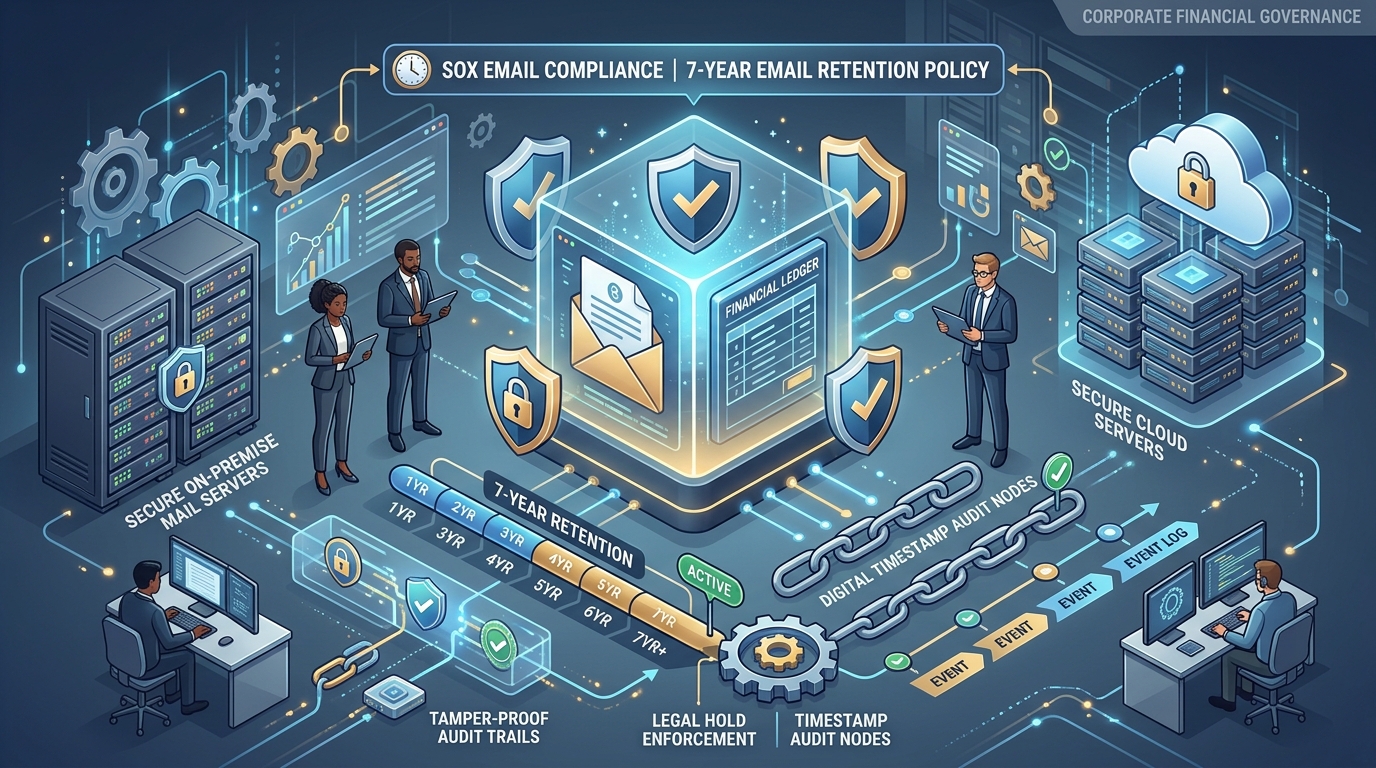
Sarbanes-Oxley (SOX) does not contain a stand-alone statutory rule that says "keep every email for X years." What it does do is make it a federal crime to destroy or alter records to obstruct an investigation, mandate that accounting firms preserve audit records for seven years, and require public corporations to enforce internal controls over financial reporting. Email communications sit right at the center of all three mandates—which is why most organizations retain financial-related email for about seven years and shield it from deletion, tampering, or unmonitored exfiltration.
⚡ Key Takeaways
- SOX never explicitly names email: However, email is legally recognized as a business "record" whenever it pertains to financial reporting, internal controls, or audit substantiation.
- The origin of the seven-year rule: The seven-year timeline stems directly from audit-record retention mandates (SOX Section 802, 18 U.S.C. § 1520, and SEC Rule 2-06 of Regulation S-X), and most public companies adopt it as their practical corporate standard.
- Integrity outweighs retention clocks: The paramount compliance risk is not simply how long you store email, but whether you can prove it is complete, unaltered, tamper-evident, and promptly retrievable during an audit or regulatory review.
- Legal holds supersede scheduled deletion: Automated mailbox deletion and cleanup rules must halt immediately when a legal hold, regulatory inquiry, or internal investigation becomes reasonably anticipated.
- Disclaimer: This article provides general educational information and does not constitute formal legal advice. Always verify your retention schedules and policies with qualified legal counsel and external auditors.
Table of Contents
- What SOX Actually Says (and Doesn't Say)
- Which Emails Count as SOX Records?
- How Long Should You Keep Emails for SOX?
- Legal Holds: Where Retention Policies Fail
- Mid-Article Consultation
- The Five Most Common SOX Email Gaps
- Mapping Email Controls to SOX Expectations
- Platform Notes: Where to Configure Retention
- Beyond Storage: Control What Leaves and Prove What Happened
- A Practical SOX Email Retention Policy Outline
- SOX Email Readiness Checklist
- Common Mistakes to Avoid
- Frequently Asked Questions
- Final Thoughts
What SOX Actually Says (and Doesn't Say)
Many IT and compliance teams quote SOX as if it contained a neat, itemized schedule specifying exact retention lengths for electronic mail. It does not. Instead, SOX establishes stringent legal obligations regarding corporate accountability, audit preservation, and financial control integrity. Here are the statutory provisions that govern email in practice:
| SOX Provision | What It Covers | Why It Matters for Email |
|---|---|---|
| Section 302 | CEO and CFO must personally certify the accuracy of quarterly and annual financial statements and the effectiveness of internal disclosure controls. | Email exchanges establish how financial figures were derived, reviewed, debated, approved, or adjusted prior to certification. |
| Section 404 | Management and external auditors must assess and report on the effectiveness of Internal Controls over Financial Reporting (ICFR). | Email evidence directly substantiates control operation (e.g., manager sign-offs, variance reviews, credit memo authorizations, exception approvals). |
| Section 802 | Criminalizes destroying, altering, or falsifying records to impede federal matters (18 U.S.C. § 1519), and establishes audit record retention rules (18 U.S.C. § 1520). | Forms the bedrock legal basis for enterprise email retention schedules, legal hold preservation, and the standard seven-year retention practice. |
| Section 806 | Protects corporate whistleblowers from retaliation when reporting suspected securities violations or accounting fraud. | Internal fraud and retaliation investigations rely heavily on uncompromised historical email records, timestamps, and recipient logs. |
| Section 906 | Imposes severe criminal penalties (up to $5 million in fines and 20 years in federal prison) for willfully certifying non-compliant financial reports. | Raises the executive stakes of unpreserved, missing, deleted, or retrospectively modified correspondence. |
Among these, Section 802 is the statute most frequently cited in email retention policies. It contains two distinct legal prongs that organizations often conflate:
- Record destruction and obstruction (18 U.S.C. § 1519): Makes it a felony for anyone to knowingly alter, destroy, mutilate, conceal, or falsify any document or electronic record with the intent to impede, obstruct, or influence an actual or contemplated federal proceeding. This applies universally to corporations, executives, and employees—not just auditors.
- Audit record retention (18 U.S.C. § 1520 & SEC Rule 2-06): Imposes a direct obligation on certified public accounting firms to maintain audit workpapers, memoranda, correspondence, and electronic records relating to public company audits for a mandatory period of seven years after the conclusion of the audit.
While Section 802 explicitly mandates the seven-year rule for the accounting firm, public corporations have overwhelmingly adopted seven years as the de facto operational benchmark for all internal records supporting financial reporting.
Quick Take: SOX is fundamentally about record integrity and evidentiary defensibility rather than a simple countdown timer. If you cannot prove an email was captured intact, preserved against alterations, and deleted only pursuant to a documented corporate schedule, keeping files for seven years will not protect you in an audit.
Which Emails Count as SOX Records?
A frequent error is assuming that every single email sent or received by any employee in the company is a SOX record. In reality, retaining spam, personal banter, lunch orders, and marketing collateral indefinitely creates massive legal exposure and bloated eDiscovery costs. Organizations must identify and categorize messages that directly substantiate financial reporting, internal controls, or audit disclosures:
- Approvals and sign-offs: Communications approving journal entries, manual accruals, bad-debt write-offs, capital expenditure authorizations, and period-end ledger adjustments.
- Financial close communications: Threaded discussions between corporate finance, business unit controllers, and regional accounting teams concerning revenue figures, inventory valuations, and reserves.
- External auditor correspondence: Official inquiries, document requests, audit testing samples, management representation letters, and formal auditor responses.
- Audit Committee and Board packets: Meeting minutes, executive summaries, presentations, and email discussions regarding material financial risks, internal controls, and disclosure decisions.
- Revenue recognition and contracting: Sales negotiations, special terms, discount approvals, side letters, and contract revisions that dictate how revenue is recognized under ASC 606 / IFRS 15.
- Disbursement and banking changes: Vendor master file alterations, wire transfer confirmations, banking routing changes, and signature authority updates that govern cash disbursements.
- Automated financial system notifications: Automated system emails, ERP workflow approvals, purchase order dispatches, and automated payment receipts (for an in-depth breakdown, read our guide to the ERP email governance gap).
- Whistleblower reports and fraud investigations: Emails received through ethics hotlines, grievance logs, special committee investigations, and HR remediation records.
- Control exceptions and remediation: Documentation of failed control tests, deficiencies, material weaknesses, and the corresponding corrective action plans.
The Auditor Litmus Test: If an external auditor, PCAOB inspector, or SEC investigator could reasonably demand to see this communication to understand how an accounting figure was derived or validated, it is within SOX scope and must be preserved.
How Long Should You Keep Emails for SOX?
Across enterprise compliance programs, the standard retention target for financial records is seven years. There are three primary reasons why this consensus exists:
- Alignment with SEC Rule 2-06: It mirrors the statutory seven-year retention period imposed on external accounting firms, ensuring that corporate client records match the auditor's workpaper timelines.
- Statute of limitations coverage: Seven years comfortably spans federal tax audit statutes of limitations (typically three to six years under IRS rules) and federal securities litigation discovery windows.
- Defensible industry precedent: PCAOB inspectors and Big Four audit partners universally recognize a seven-year schedule as defensible and standard.
Rather than treating all electronic communications identically, best-in-class compliance frameworks implement category-driven retention tiers:
| Email Category | Typical SOX-Aligned Approach |
|---|---|
| Financial Close, Approvals, & Audit Correspondence | Retain for seven years in tamper-evident, immutable storage protected from alteration and unauthorized deletion. |
| Board & Audit Committee Communications | Retain per corporate charter and governance policy, typically seven to ten years, or permanently for core governance artifacts. |
| General Business & Operational Email | Shorter retention (typically 1 to 3 years) based on business necessity, automatically purged to reduce risk and storage overhead. |
| Email Subject to Legal Hold | Preserve indefinitely. All scheduled deletion rules, auto-cleanup scripts, and user purging must be frozen until formal release. |
Legal Holds: Where Retention Policies Fail
In corporate litigation and regulatory enforcement, the most catastrophic penalties do not occur because a company had a 5-year retention rule instead of 7. They occur when a company continues deleting emails after a duty to preserve has attached.
Under federal spoliation doctrine and SOX Section 802, the moment a public company reasonably anticipates an investigation, SEC inquiry, whistleblower allegation, or financial audit dispute, it incurs an affirmative legal duty to freeze all deletion. The hold procedure must encompass:
- Immediate suspension of automated deletion: Halting mailbox quota auto-cleanups, retention lifecycle purges, and automated inbox archive scripts for all identified custodians.
- Scoping non-standard accounts: Expanding the preservation scope beyond primary user mailboxes to include shared mailboxes, finance distribution groups, service accounts, and system-generated notifications.
- Custodial tracking and confirmation: Issuing formal legal hold notices, logging affirmative acknowledgments from custodians, and maintaining a verifiable audit trail of hold issuance dates.
- Defensible release protocols: Documenting the legal rationale and executive approval required before lifting a hold and resuming standard lifecycle deletion.
Is Your Email Setup Defensible Against SOX Auditors?
MailGovern helps finance, IT, and compliance leaders automatically classify financial communications, enforce legal holds, stop outbound data leakage, and maintain immutable audit trails across Microsoft 365, Google Workspace, and Exchange Server.
The Five Most Common SOX Email Gaps
When external auditors and compliance assessors test corporate email programs against SOX 404 control standards, they routinely uncover five recurring vulnerabilities:
- Auto-delete rules running ahead of policy: Individual users setting personal inbox cleanup rules, aggressive 30-day "Deleted Items" folder purges, or storage quota limits that silently wipe out evidentiary approvals before the 7-year mark.
- Service accounts and automated system mail excluded: ERP systems, invoicing software, and payroll portals frequently dispatch critical transactional confirmations and sign-offs from generic accounts (e.g.,
finance-alerts@company.com) that are never assigned retention tags or archived. - Inconsistent policies across hybrid or mixed environments: Enterprises operating split environments—such as Exchange Online alongside legacy on-premise Exchange Servers—often configure retention in the cloud while neglecting on-premise mailboxes. For insights on managing legacy systems, read whether on-premise Exchange compliance is still defensible in 2026.
- Shadow communications and personal accounts: Finance team members forwarding spreadsheets, draft filings, and journal entry rationale to personal webmail (Gmail, Yahoo) or unmonitored messaging apps, breaking the chain of custody and escaping the corporate archive.
- Lack of an immutable audit trail: Archiving messages without tamper-evident logging is insufficient. Auditors expect to see who accessed, modified, exported, searched, or attempted to delete sensitive financial correspondence.
Mapping Email Controls to SOX Expectations
To pass SOX Section 404 internal control testing, your technical email architecture must directly support auditor expectations:
| What Auditors Want to See | Email Control That Supports It |
|---|---|
| Records are complete | Comprehensive retention and archiving policies that encompass all user mailboxes, shared inboxes, and system service accounts. |
| Records are unaltered | WORM (Write Once, Read Many) or tamper-evident cryptographic storage with restricted, segregated administrator permissions. |
| Records are retrievable | High-speed indexed search, granular metadata filters, and validated eDiscovery export routines tested on a regular cadence. |
| Deletion strictly follows policy | Formally documented corporate retention schedules enforced via automated policy rules rather than discretionary end-user manual actions. |
| Legal holds are strictly honored | Immediate custodian-level hold triggers that unconditionally override scheduled retention purges across all environments. |
| Sensitive financial data is protected | Context-aware content classification and real-time outbound DLP controls that prevent unauthorized exfiltration of quarterly earnings drafts and banking data. |
| All actions are traceable | Comprehensive audit trails detailing every administrator access, search query, export event, policy revision, and deletion attempt. |
The final two rows represent the boundary where basic native email tools often fall short. Standard mail platforms store messages effectively, but lack context-sensitive outbound DLP and unified cross-platform reporting. For an explanation of why traditional filtering falls short, see why basic Office 365 DLP fails at context.
Platform Notes: Where to Configure Retention
Compliance cannot operate in silos. Your retention schedules and legal hold enforcement must remain uniform across every platform your company uses:
- Microsoft 365 and Exchange Online: Microsoft Purview offers native retention policies and Litigation Hold. However, you must verify that retention labels apply explicitly to shared mailboxes, executive secondary archives, and automated forwarding rules. Purpose-built Exchange Online email automation ensures these rules remain synchronized without manual overhead.
- Google Workspace: Google Vault provides retention rules and legal holds for Gmail. Ensure rules are mapped correctly across all Organizational Units (OUs) and that automated service accounts are not placed in excluded root organizational units. Comprehensive Google Workspace email compliance ensures parity with Microsoft-centric audit requirements.
- Exchange Server and Hybrid Topologies: On-premises environments require dedicated database retention configuration and journaling. Dedicated on-premise email governance compliance bridges the gap, ensuring on-premises servers enforce identical 7-year retention and legal holds as cloud tenants.
Beyond Storage: Control What Leaves and Prove What Happened
Modern SOX compliance is no longer just a passive archiving exercise. Regulators and auditors increasingly expect organizations to demonstrate preventive and detective controls over confidential financial data moving out of the company.
This is where real-time outbound email monitoring and control becomes essential: scanning outbound email for unannounced quarterly financials, payroll rosters, wire details, and M&A drafts; holding questionable transmissions in compliance review queues; and logging every intervention. When combined with advanced classification (as detailed in our guide to email classification software), organizations can prove to auditors that financial data was governed at every step.
By leveraging unified enterprise email compliance software, compliance officers gain a single pane of glass uniting classification, outbound protection, immutable archiving, and verifiable audit trails.
A Practical SOX Email Retention Policy Outline
Use the following ten-point operational blueprint as a foundation when authoring or revising your organization's formal email retention policy:
- 1. Purpose and Scope: Explicitly state that the policy establishes controls supporting corporate financial reporting integrity under SOX Sections 302, 404, and 802 across all corporate mail platforms.
- 2. Record Classification Categories: Clearly define what constitutes a financial/SOX record versus ephemeral or operational business correspondence.
- 3. Retention Timeframes: Formulate specific retention periods by category, setting the standard seven-year requirement for all financial, tax, and audit-related emails.
- 4. Storage & Immutable Archiving: Require that financial communications be preserved in access-controlled, tamper-evident, or WORM storage environments.
- 5. Authorized Deletion Protocols: Strictly forbid manual ad-hoc user purges; mandate that record disposal occur solely via documented, automated lifecycle routines.
- 6. Legal Hold Workflow: Identify designated corporate authorities (e.g., General Counsel) empowered to initiate legal holds and mandate the instantaneous cessation of scheduled deletion.
- 7. Ingestion of Service & System Accounts: Formally mandate that transactional accounts used by ERP, billing, and accounting systems be covered by retention policies.
- 8. Prohibited Communication Channels: Explicitly ban using personal email accounts, SMS, or unapproved consumer chat apps for discussing corporate financial matters.
- 9. Immutable Audit Logging: Require detailed system logging for all archive access, administrative queries, exports, and hold operations.
- 10. Annual Testing & Recertification: Mandate annual testing of eDiscovery retrieval speeds, legal hold responsiveness, and policy reviews following corporate mergers or platform migrations.
SOX Email Readiness Checklist
Evaluate your organization's compliance posture with this straightforward readiness assessment:
Common Mistakes to Avoid
- Quoting SOX as an email deadline: Stating to auditors that "SOX requires email retention for 7 years" demonstrates regulatory misunderstanding. Frame your policy around Section 802, SEC Rule 2-06 alignment, and Section 404 control evidence.
- Applying a single blanket retention period: Attempting to keep every single enterprise email for seven years inflates litigation discovery costs and storage expenses, while keeping everything for 1 year destroys audit evidence. Categorization is mandatory.
- Neglecting legal hold automation: Assuming manual user notification is sufficient during litigation. Auto-delete scripts must be programmatically suspended at the infrastructure level.
- Viewing retention as an IT-only issue: Treating email archiving as basic storage capacity rather than a joint governance responsibility owned by Finance, Legal, and Compliance.
- Failing to test post-migration integrity: Moving mailboxes between on-premises Exchange and Microsoft 365 without validating that historical tags, litigation holds, and retention policies carried over seamlessly.
- Relying on voluntary user compliance: Counting on busy employees to manually drag financial approvals into specific archive folders. All archiving and classification must be policy-automated.
Frequently Asked Questions
Does Sarbanes-Oxley require email archiving?
How long should emails be kept for SOX compliance?
What is SOX Section 802?
Does SOX email retention apply to private companies?
Are automated emails from ERP and finance systems covered under SOX?
What happens if emails are deleted during an active investigation?
Final Thoughts
Sarbanes-Oxley does not hand you a simple, one-line email retention rule. It demands something far more rigorous: that your organization preserves the right financial evidence, protects it against unauthorized alteration, halts deletion instantaneously when legal holds arise, and proves every transaction through an immutable audit trail. Organizations that succeed in audit reviews are those that deploy structured classification, automated retention schedules across all mail environments, and proactive outbound oversight.