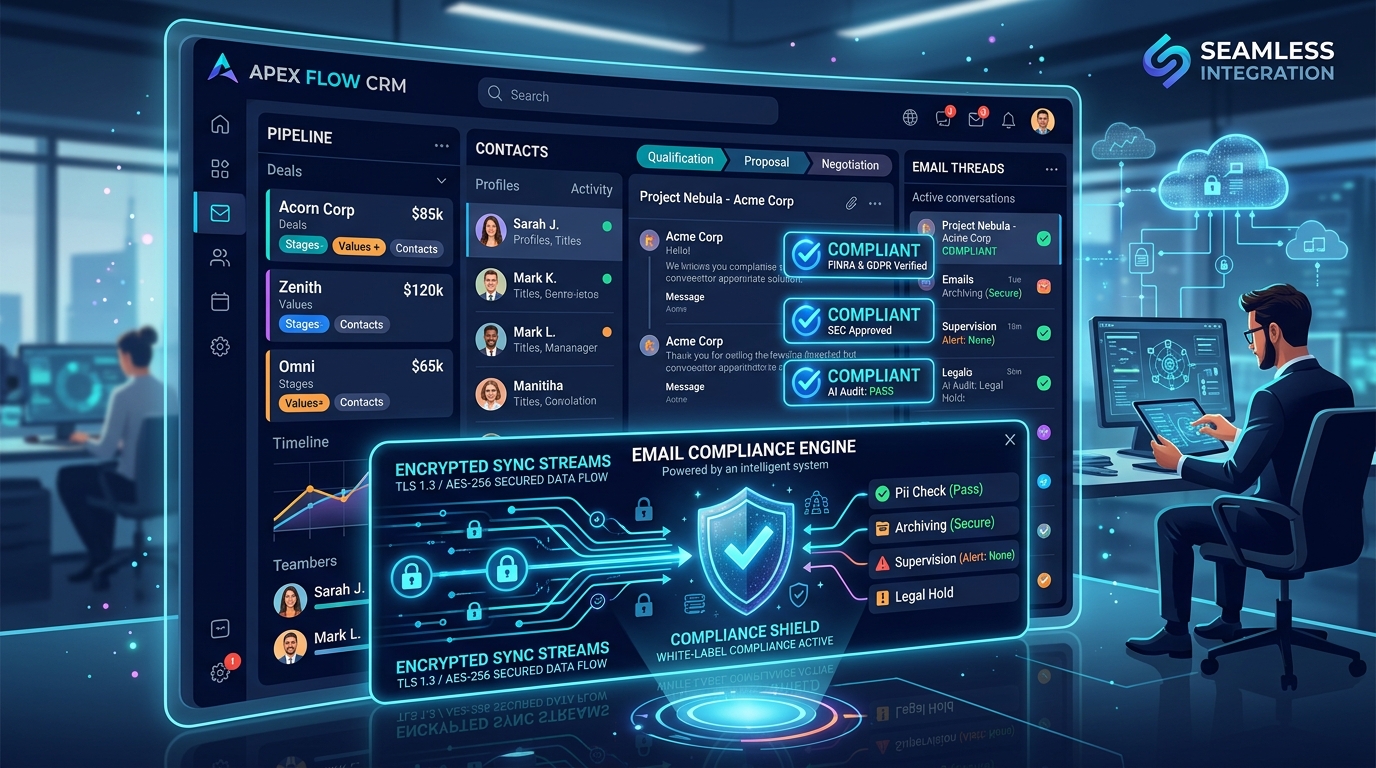
White-label email compliance means embedding another vendor's specialized email compliance engine inside your own CRM platform under your own brand. This equips your customers with automated classification, outbound DLP control, regulatory retention, and audit trails without your engineering team building them from scratch. For CRM vendors, it is often the fastest way to answer a decisive question enterprise buyers now ask in every procurement review: "How do you keep the email we sync into your CRM compliant?"
⚡ Key Takeaways
- CRMs sit on sensitive communication: Modern CRM platforms capture customer deals, contracts, financial negotiations, and proprietary pricing threads—turning the CRM into a second home for regulated data.
- The strategic routes: You have three options: build in-house, bolt on a third-party point tool, or white-label an email governance platform. White-labeling overwhelmingly wins on time-to-market and lifetime ROI unless compliance is your core product.
- Deciding factors: The real differentiators are integration depth, strict multi-tenant isolation, auditability, and how completely the partner disappears behind your brand.
- Comprehensive evaluation: Evaluate potential partners on total mail-platform coverage (Exchange Online, Google Workspace, and on-premises Exchange), secure data handling, and transparent exit terms—not just feature lists.
Table of Contents
- Why CRM Platforms Are Being Pulled Into Email Compliance
- What White-Label Email Compliance Actually Includes
- Build vs Buy vs White-Label
- Integration Depth: The Make-or-Break Criterion
- The Buyer's Evaluation Checklist
- Questions to Ask Every Vendor
- Common Buying Mistakes
- A Simple Rollout Plan
- Frequently Asked Questions
- Final Thoughts
Why CRM Platforms Are Being Pulled Into Email Compliance
A CRM used to store simple contact records and sales notes. Today, it automatically ingests full email threads, executive attachments, contract revisions, and meeting transcripts synced directly from each rep's mailbox. That makes the CRM a major repository of regulated, financial, and confidential data.
Three industry market forces are accelerating this shift:
- Enterprise buyers demand answers during procurement: Security and compliance questionnaires now examine how synced email data is segregated, audited, and retained inside third-party SaaS apps.
- Regulated industries require defensible proof: Financial institutions (FINRA/SEC), healthcare organizations (HIPAA), and public sector entities must demonstrate that copies of emails synced to CRM accounts obey corporate retention schedules and legal holds.
- Competitors are bundling compliance features: As leading CRM platforms introduce native email governance and DLP capabilities, prospects increasingly ask competing vendors why their software lacks built-in protection.
The business risk for a CRM vendor is stark: if compliance sits outside your product scope, high-value enterprise deals stall in procurement or defect to vendors who offer an integrated solution.
What White-Label Email Compliance Actually Includes
While the exact scope varies by vendor, a comprehensive white-label governance engine delivers seven core capabilities:
To examine the semantic classification engine in greater depth, our guide to email classification software details how AI inspects attachments, intent, and message bodies.
Build vs Buy vs White-Label
CRM product leadership teams evaluating this requirement typically weigh three architectural options:
Strategic Recommendation: Build in-house only if email compliance is the primary core value proposition of your company. For virtually all CRM software providers, white-labeling a mature email governance platform unlocks immediate enterprise readiness, delivers instant revenue expansion, and presents a seamless branded experience without diverting core product engineers.
Integration Depth: The Make-or-Break Criterion
A white-label compliance layer is only as defensible as its native connection to where your customers' emails originate. Enterprise CRM clients operate across heterogeneous email environments:
1. Microsoft Exchange Online
The vast majority of enterprise sales organizations operate on Microsoft 365. Your compliance partner must integrate via enterprise Graph APIs, support tenant-level OAuth consent, and seamlessly process both user mailboxes and shared inboxes. A resilient Exchange Online CRM integration operates invisibly in the mail stream, leveraging Microsoft Graph API email automation instead of fragile local plugins.
2. Google Workspace
Fast-scaling tech companies and digital enterprises standardize on Google Workspace. The white-label engine must offer equivalent native support for Gmail labels, retention schedules, and admin policies, delivering authentic Google Workspace email compliance rather than a shallow SMTP connector.
3. On-Premises & Hybrid Exchange
Large enterprises in banking, government, and healthcare frequently maintain on-premises Exchange servers or complex hybrid deployments. If your white-label solution only supports cloud mail, you will forfeit deals with the largest enterprise clients. Ensure your partner supports on-premise email governance compliance. For technical context, review our analysis on whether on-premise Exchange compliance is still defensible in 2026.
4. The Sales Desktop (Outlook Integration)
Sales professionals spend their day inside Outlook. Providing an Outlook add-in for CRM integration enables reps to sync and categorize messages directly at the point of action, enforcing compliance rules before an email is sent.
Quick take: Count the email platforms your customers run. If your white-label compliance partner cannot cover all of them, the resulting coverage gaps become your company's support burden.
Adding Email Compliance to Your CRM Platform?
Talk to the MailGovern team about embedding AI classification, outbound control, and defensible audit trails across Exchange Online, Google Workspace, and Exchange Server—entirely under your brand.
The Buyer's Evaluation Checklist
Score prospective white-label compliance partners across these four critical operational dimensions (1 to 5 scale):
1. Product & Compliance Capabilities
- Semantic context-aware classification (NLP/AI) rather than basic keyword lists.
- Deep attachment and image OCR scanning for embedded PII, PHI, and financial records.
- Outbound policy enforcement with customizable confidence thresholds and escalation queues.
- WORM-compliant retention and legal hold across both cloud and on-premises mailboxes.
- Comprehensive, exportable audit trail with immutable tamper-evident logs.
- Explainable decision logs so tenant administrators can verify why a message was flagged.
2. White-Label & Embedding Specifics
- Complete visual rebranding: custom logo, product naming, custom subdomains, and email notifications.
- True multi-tenant architecture with cryptographic data isolation between your customer accounts.
- Delegated administration allowing each customer admin to configure their own policies.
- Modern REST APIs and SDKs to embed features natively into your CRM interface.
- Flexible provisioning and billing hooks that match your pricing tiers and packaging.
3. Trust, Security & Operations
- Transparent data residency options and clear geographic processing boundaries.
- SOC 2 Type II, ISO 27001, and HIPAA compliance attestations.
- Contractual uptime commitments (99.9%+), robust SLAs, and dedicated partner support.
- Predictable product release cycles with partner influence over future roadmap items.
4. Commercial Terms & Flexibility
- Transparent pricing model (per-tenant, per-mailbox, or usage-based).
- Healthy margin room allowing you to package compliance as a lucrative premium tier.
- Favorable exit clauses, guaranteed data portability, and structured transition support.
Questions to Ask Every Vendor
- Which email platforms do you natively support today, and what specific features are on your roadmap with firm dates?
- How is each of our customer tenants isolated at the database, memory, and encryption key levels?
- Can our customers' administrators view and manage strictly their own policies without seeing our other tenants?
- What specific elements of your interface can be customized, and is any underlying vendor branding visible to end users?
- Do you expose comprehensive REST APIs for all compliance operations, or are certain features restricted to your pre-built UI?
- What is the precise protocol and SLA for extracting and returning customer compliance data if our partnership ends?
- How does your engineering team support regulatory inquiries or customer security audit requests on our behalf?
- What is your release schedule, and how do you guarantee that upstream updates will never disrupt our integrated CRM workflows?
Common Buying Mistakes
- Choosing based on feature checklists alone: Integration resilience, uptime reliability, and multi-tenant data isolation matter far more over the long term.
- Overlooking on-premises Exchange customers: Legacy and hybrid organizations often represent your highest-ACV enterprise accounts.
- Underestimating technical support coordination: Establish clear tier-1 and tier-2 support boundaries for compliance questions before launching.
- Failing to negotiate exit terms upfront: Partner dependency is manageable when data portability and termination timelines are clearly codified.
- Rebranding only the logo: If email alerts, documentation links, or error modals reveal a third party, your white-label value is diminished.
- Treating compliance as a one-time feature launch: Compliance requires ongoing rule maintenance as privacy regulations and threat landscapes evolve.
A Simple Rollout Plan
- Define initial scope: Launch with core essentials: automated sensitivity classification, outbound DLP warnings, and immutable audit logs.
- Execute partner POC: Validate integration depth on real email flows across Microsoft 365 and Google Workspace test tenants.
- Pilot with friendly design partners: Onboard 3 to 5 existing customers in regulated verticals (such as financial advisory or legal services).
- Structure commercial packaging: Bundle the compliance engine as an "Enterprise Governance" or "Compliance Plus" premium CRM tier.
- Enable customer-facing teams: Train your sales and solution engineering teams to master compliance questionnaires.
- Scale enterprise-wide: Broaden coverage to additional mail platforms and vertical markets based on pilot telemetry.
Frequently Asked Questions
What is white-label email compliance?
White-label email compliance is an arrangement where a specialized vendor provides an email governance and compliance engine that you embed directly inside your CRM software under your own brand, logo, and domain.
Why would a CRM platform white-label instead of building internally?
Building email compliance from scratch takes 12 to 24 months of specialized development and substantial ongoing maintenance. White-labeling delivers enterprise-ready compliance in weeks at predictable cost while keeping your core engineering focused on CRM features.
What should a CRM vendor look for in a white-label partner?
Key priorities include multi-platform coverage (Exchange Online, Google Workspace, Exchange Server), strict multi-tenant cryptographic isolation, 100% white-label customization, robust REST APIs, and favorable commercial exit terms.
Does white-label email compliance work with Microsoft 365 and Google Workspace?
Yes. Leading white-label providers integrate natively with Microsoft 365 via Graph API and Google Workspace via Gmail APIs, as well as supporting on-premises and hybrid Exchange environments.
How long does implementation take?
Depending on whether you choose API-level embedding or pre-styled UI components, a focused proof-of-concept can be deployed in 2 to 4 weeks, with a full production rollout completed in 6 to 8 weeks.
How is customer data kept separate between CRM tenants?
Enterprise compliance partners implement multi-tenant architectures featuring logical and cryptographic separation, tenant-specific encryption keys, and delegated RBAC controls so no customer can ever view another tenant's data.
Final Thoughts
Email compliance is rapidly evolving from a niche add-on into a mandatory table-stakes requirement for enterprise CRM software. The most effective approach for CRM vendors is to partner with a mature enterprise email compliance software provider that covers the diverse mail environments your customers run. Focus your vendor evaluation on integration depth, strict multi-tenant isolation, and transparent exit terms—not on superficial feature lists alone.