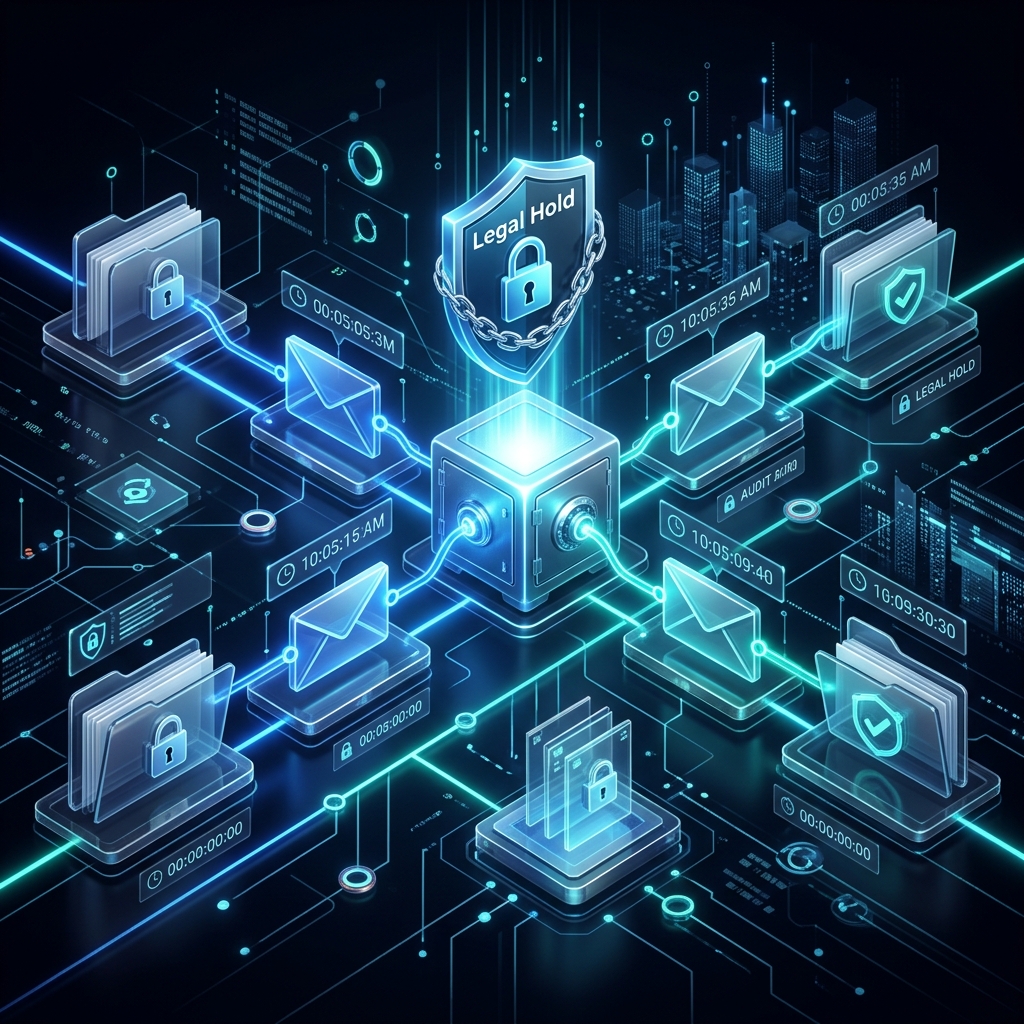
Defensible legal hold is a standard of process—not a marketing buzzword—that proves an organization took reasonable, systematic, and documented steps in good faith to preserve relevant information when litigation is anticipated. When courts evaluate spoliation of evidence claims, they don’t just ask if you kept the data; they ask if your process for keeping it was defensible. A core pillar of this defense is an immutable, tamper-evident email audit trail that demonstrates an unbroken chain of custody from the moment the hold was triggered.
In the context of eDiscovery and Federal Rule of Civil Procedure (FRCP) 37(e), maintaining a defensible process is an organization's primary shield against severe sanctions. This guide breaks down exactly what "defensible" means in practice, why legacy approaches to email preservation often fail, and the critical elements your email audit trail must capture to survive judicial scrutiny.
Understanding the nuances of a defensible legal hold is no longer a luxury reserved for massive multinational corporations. With the exponential growth of data privacy regulations and the increasing frequency of civil litigation, organizations of all sizes must be prepared. The failure to maintain a defensible legal hold process—and by extension, a reliable email audit trail—can result in devastating consequences that stretch far beyond the courtroom, impacting brand reputation and operational stability. Note: This post provides general information on best practices and should not be construed as legal advice.
Table of Contents
- What "Defensible" Actually Means in a Legal Hold Context
- What Triggers a Legal Hold and Why Email is High-Risk
- What a Defensible Audit Trail Must Capture
- Common Ways Audit Trails Fail Defensibility
- How to Build a Defensible Process
- Frequently Asked Questions
What "Defensible" Actually Means in a Legal Hold Context
In legal and eDiscovery contexts, the term "defensible" does not mean perfect or infallible. According to the advisory committee notes for FRCP 37(e), perfection in preserving all relevant electronically stored information (ESI) is often impossible. Instead, defensibility centers on the concepts of "reasonableness and good faith." A defensible legal hold process is one that is systematic, documented, consistently applied, and capable of being clearly explained and justified to opposing counsel or a judge.
If evidence is lost, the court will evaluate whether the loss was accidental despite a robust preservation process, or if it occurred because the organization failed to take reasonable steps. A defensible email audit trail is the tangible proof of those reasonable steps. It provides the court with a verifiable history of who initiated the hold, when it was applied, what data sources were secured, and how that data was protected against alteration or deletion.
Without this documentation, organizations are left relying on oral testimonies and assumptions, which rarely satisfy the burden of proof required to fend off spoliation claims. A defensible audit trail transforms a fragile oral defense into a solid, evidence-based demonstration of compliance. Deploying an email governance platform with robust capabilities is essential to building this defense.
What Triggers a Legal Hold and Why Email is High-Risk
The duty to preserve evidence is triggered the moment litigation is "reasonably anticipated." This does not always mean waiting for a formal complaint or subpoena. Triggers can include a credible threat of a lawsuit, a regulatory inquiry, or an internal investigation into severe misconduct. Once this trigger occurs, routine document destruction policies—such as auto-purging deleted emails after 30 days—must be suspended for relevant custodians.
Email is considered a high-risk data source during legal holds for several reasons:
- Volume and Velocity: Thousands of emails are sent and received daily, making manual preservation nearly impossible.
- Informal Nature: Employees often treat email informally, increasing the likelihood of relevant, unprotected statements existing within their inboxes.
- Automated Deletion: Most organizations enforce automated lifecycle management to reduce storage costs. If these scripts are not promptly paused, relevant evidence is routinely destroyed.
- Scattered Infrastructure: Emails may exist in live mailboxes, local PST files, cloud archives, or mobile devices, complicating comprehensive preservation.
Because of these risks, relying on custodians to self-preserve data by moving emails to a "Legal Hold" folder is highly discouraged and widely considered indefensible. Instead, organizations must rely on centralized enterprise email compliance software to enforce holds globally.
What a Defensible Audit Trail Must Capture
A simple log stating "Hold applied on Tuesday" is insufficient. To meet the standards of a defensible email audit trail for legal hold, the system must automatically capture a granular, chronological record of events.
Chain of Custody and Access Logging
Chain of custody is the chronological documentation that records the sequence of custody, control, transfer, analysis, and disposition of electronic evidence. Your audit trail must explicitly log who accessed the preserved data, when they accessed it, and from where (IP address). If the data is transferred to outside counsel or an eDiscovery vendor, the trail must record the exact export parameters and hashes of the exported volumes to prove the data was not tampered with during transit.
Timestamped Preservation and Collection Events
Every action taken regarding the legal hold must be stamped with a precise, synchronized timestamp (preferably UTC). This includes:
- The exact moment the hold was initiated in the system.
- The moment the automated deletion policies were suspended for specific custodians.
- When any searches or collections were run against the preserved data.
- The exact time the hold was ultimately released when the matter resolved.
These timestamps are critical for proving that the organization acted promptly after the preservation duty was triggered.
Proof of Consistent Application
A defensible process must be applied consistently. If an organization applies holds for lower-level employees but exempts executives from the same restrictions due to "operational convenience," the entire process can be deemed indefensible. The audit trail must demonstrate that the hold parameters—such as date ranges, keywords, and custodian lists—were applied uniformly across the designated scope without selective omission or deletion.
Documentation of Hold Notifications
While backend preservation is crucial, organizations must also instruct custodians not to destroy data on local devices or alternative platforms. A robust audit trail includes a ledger of Legal Hold Notices. It should track when notices were sent, to whom, and capture digital acknowledgments proving that the custodians read and understood their preservation duties. Follow-up reminders for non-responsive custodians must also be logged.
Immutable and Tamper-Evident Logging
An audit trail is only as valuable as its integrity. If an IT administrator can edit the log to cover up a mistake, the log is worthless in court. A defensible eDiscovery audit trail must be immutable (Write-Once-Read-Many) or highly tamper-evident. Any attempt to alter the log should generate a high-priority security alert and record the unauthorized modification attempt. Using cryptographic hashing to seal the logs on a daily basis is a strong best practice.
Common Ways Audit Trails Fail Defensibility
Understanding how organizations lose spoliation arguments helps in designing a better process. Common failure points include:
- The "IT Ticket" Method: Relying on email requests to IT (e.g., "Please put John Doe on hold") without a centralized tracking system. These tickets get lost, delayed, or closed without actual execution.
- Custodian Self-Preservation: Trusting employees to search their own inboxes and preserve relevant emails. Courts have repeatedly ruled this method is flawed, as custodians may be biased or technically incapable of conducting thorough searches.
- Gaps in the Timeline: Audit trails that show a hold was placed, but fail to log when automated deletion was actually paused, leaving a window where evidence could have been destroyed.
- Lack of Release Documentation: Keeping holds in place forever ("data hoarding") because the organization forgot to release them. While not immediately a spoliation risk, this drastically inflates future eDiscovery costs and violates data minimization principles discussed in our email retention state and industry guide.
The Balance of Proportionality and Reasonableness
It is important to remember that FRCP 37(e) and general legal hold doctrines do not demand the impossible. Courts frequently weigh preservation efforts against the concept of proportionality. The efforts and costs expended to preserve data should be proportional to the needs of the case, the amount in controversy, and the parties' resources.
However, "proportionality" is never an excuse for negligence. If an organization fails to take the basic, inexpensive step of halting its automated email deletion scripts for key custodians, no argument of proportionality will save it from sanctions. The audit trail is your primary tool for proving that your efforts were both reasonable and appropriately scaled to the threat at hand. When you can produce a pristine log showing exactly what was preserved and why, you control the narrative surrounding your compliance efforts.
How to Build a Defensible Process
Transitioning from ad-hoc preservation to a defensible, automated process requires aligning people, policies, and technology. Follow these steps to verify and enhance your approach:
- Document Your Legal Hold Policy: Before purchasing software, clearly define in writing what triggers a hold, who has the authority to issue one, and the standard procedures for custodian notification.
- Integrate Legal and IT Workflows: Empower the legal team to initiate holds directly through an Exchange Server on-premise email automation or Exchange Online email automation interface, removing the IT bottleneck and ensuring instant preservation.
- Automate In-Place Preservation: Utilize technology that preserves emails "in-place" silently, without requiring custodians to change their behavior or move files to archive folders.
- Standardize Notification Templates: Create clear, non-jargon-heavy templates for hold notices and implement automated tracking for custodian acknowledgments.
- Regularly Audit the Audit Trail: Conduct periodic tabletop exercises. Simulate a litigation trigger and require the team to produce the resulting audit trail to identify gaps in logging or process execution before a real judge demands it.
Frequently Asked Questions
What does 'defensible' mean in a legal hold?
In a legal hold, 'defensible' means that an organization can prove it took reasonable, systematic, and documented steps in good faith to preserve relevant information. It demonstrates to a court that the process was sound, significantly reducing the risk of spoliation sanctions even if some data is inadvertently lost.
What should an email audit trail include for a legal hold?
A defensible email audit trail must include precise timestamps of when the hold was initiated and released, a clear chain of custody showing who accessed the preserved data, records of custodian notifications and acknowledgments, and proof that automated deletion policies were successfully suspended.
What happens if a legal hold isn't defensible?
If a legal hold process is deemed indefensible and relevant evidence is destroyed, courts can impose severe sanctions under rules like FRCP 37(e). These can include monetary fines, adverse inference instructions (where the jury assumes the lost data was harmful to your case), or even default judgment.
Who is responsible for maintaining a legal hold on email?
While the legal department or general counsel usually initiates and oversees the legal hold, it is a cross-functional responsibility. IT and compliance teams are responsible for ensuring the technical infrastructure, such as an email governance platform, accurately enforces the hold and maintains the immutable audit trail.
How does an email governance platform support defensible legal holds?
An email governance platform automates the preservation process by instantly pausing retention deletion rules globally when a hold is triggered. It operates independently of end-user actions, ensuring comprehensive capture, and generates the necessary immutable, tamper-evident audit logs required for court defense.
Ready to Make Your Legal Holds Defensible by Design?
Manual legal hold processes and fragmented audit trails leave your organization vulnerable to massive eDiscovery costs and spoliation sanctions. MailGovern’s enterprise architecture provides instant, silent preservation and a tamper-evident audit trail that proves your compliance beyond a reasonable doubt.