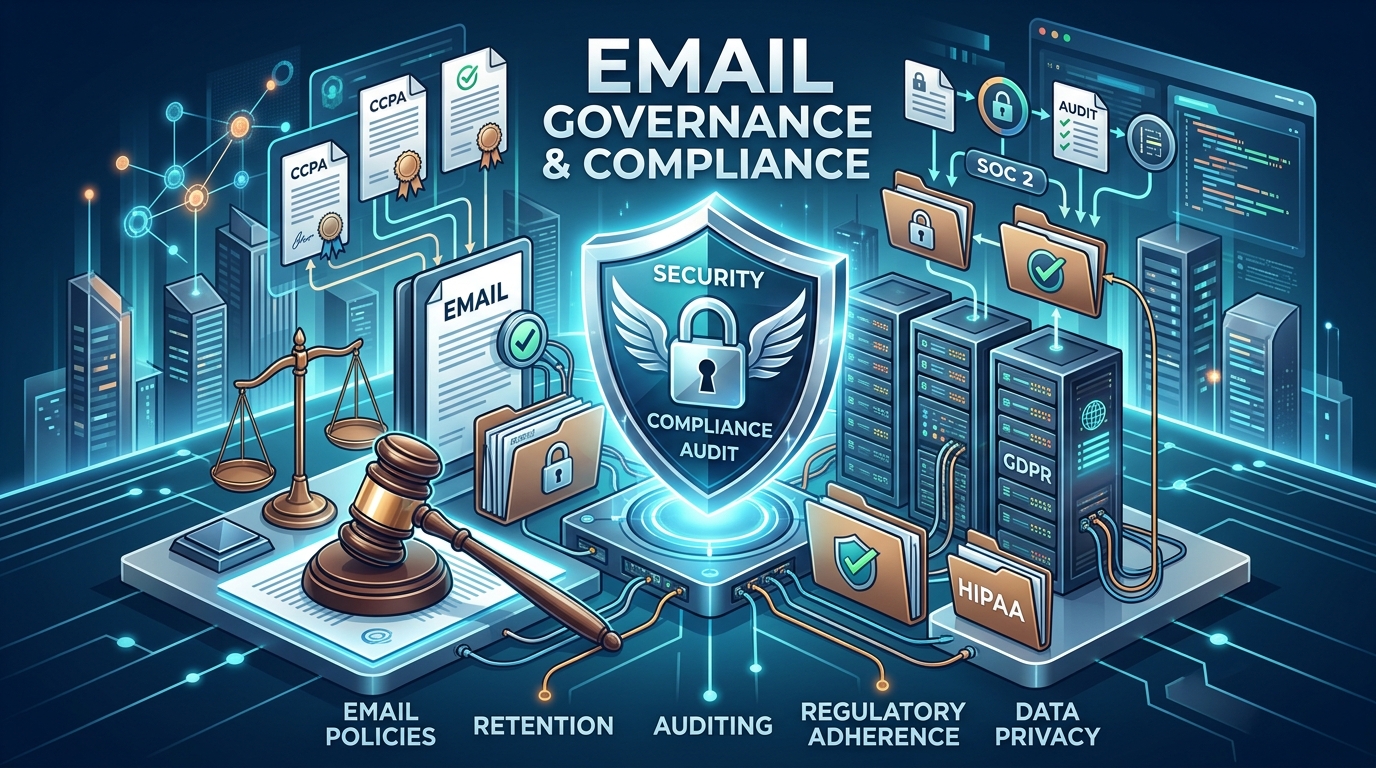
How long do you have to keep business emails? Generally, a baseline retention window for standard business correspondence is 1 to 3 years. However, this varies significantly based on state laws (like statutes of limitations and privacy acts) and strict industry-specific regulations. Keeping emails too long creates unnecessary liability, while deleting them too early can result in millions of dollars in fines for spoliation of evidence.
Table of Contents
- Why Email Retention Periods Vary
- General Baseline Retention Guidance
- State-by-State Considerations
- Industry-by-Industry Breakdown
- Common Retention Pitfalls
- Steps to Build a Defensible Email Retention Policy
- Frequently Asked Questions
Why Email Retention Periods Vary
Email retention is not a one-size-fits-all metric. It sits at the intersection of regulatory mandates, legal defense strategies, and operational necessities. From a regulatory perspective, federal agencies like the SEC or the Department of Health and Human Services (HHS) dictate strict minimums to ensure market fairness and patient privacy. From a legal standpoint, state-level statutes of limitations dictate how long you might need to defend your business against civil claims such as breach of contract or personal injury.
Furthermore, operational requirements play a role. A company may only need to keep general project updates for a year to maintain operational efficiency. This creates a complex web of requirements where an automated email retention policy enforcement system is critical. Without automation, businesses rely on employees to manually categorize and delete emails—a practice that historically fails during audits and eDiscovery.
General Baseline Retention Guidance
For organizations that do not operate in highly regulated sectors, establishing a baseline policy is the first step toward defensible deletion.
General Business Correspondence (1 to 3 Years)
Routine emails, meeting invitations, and internal project updates generally hold little long-term value. Legal experts often recommend a 1-to-3-year retention period for these communications. Keeping them longer only increases the "attack surface" for cybercriminals and the data volume that must be reviewed during litigation.
Financial and Tax Records (7 Years)
The IRS requires businesses to maintain records that support income and deductions for at least 7 years. Consequently, any email discussing payroll, major financial transactions, invoices, or tax-related decisions should be firmly locked into a 7-year retention policy.
Human Resources and Employment (4 to 7 Years)
Employment-related claims are common. Under the Fair Labor Standards Act (FLSA), certain payroll records must be kept for 3 years, but many employment attorneys recommend keeping HR-related emails for up to 7 years after an employee's departure to defend against wrongful termination or discrimination suits.
State-by-State Considerations
State laws often interact with federal and industry rules, creating local nuances that must be addressed in your email governance strategy. The primary driver of state-level retention is the statute of limitations for civil litigation.
California
In California, the statute of limitations for written contracts is 4 years, while personal injury claims are 2 years. However, California is also home to the California Privacy Rights Act (CPRA), which strictly enforces data minimization. You cannot keep consumer data longer than reasonably necessary. Balancing the 4-year contract defense window with CPRA's deletion mandates requires a precise, automated retention policy.
New York
New York has a longer statute of limitations for breach of contract—6 years. Consequently, businesses operating in New York often set their baseline retention for vendor and client communications to 6 or 7 years. Additionally, the NY SHIELD Act mandates reasonable safeguards, meaning any emails kept this long must be aggressively protected and encrypted.
Texas, Florida, and Other Jurisdictions
Texas maintains a 4-year statute of limitations for contracts, while Florida recently reduced its statute of limitations for negligence claims from 4 to 2 years (though contracts remain longer). As comprehensive privacy laws like the Texas Data Privacy and Security Act (TDPSA) roll out, the pressure to delete emails early (data minimization) will increasingly clash with the desire to keep them for legal defense.
Industry-by-Industry Breakdown
For regulated industries, the baseline rules are superseded by strict, highly enforced federal mandates.
| Industry | Typical Retention Period | Governing Regulation | Notes |
|---|---|---|---|
| Financial Services | 3 to 6 Years | SEC Rule 17a-4 / FINRA | Requires immutable (WORM) storage. Emails cannot be deleted early under any circumstance. |
| Healthcare | 6 Years (Minimum) | HIPAA / State Medical Boards | Policies and risk assessments kept 6 years; clinical emails with ePHI often kept longer based on state laws. |
| Public Companies | 7 Years | Sarbanes-Oxley (SOX) | Audit and review communications must be securely retained for 7 years post-audit. |
| Retail / eCommerce | Variable (Data Minimization) | PCI DSS / State Privacy Laws | No strict maximum, but data should be destroyed immediately when no longer needed for business purposes. |
| Legal Sector | Varies by State Bar | ABA / State Bar Rules | Often tied to the client file retention policy, usually 5 to 7 years after matter closure. |
Financial Services
Broker-dealers and financial institutions face the strictest requirements globally. Under SEC Rule 17a-4 and FINRA regulations, business-related communications must be kept for 3 to 6 years (with the first two years in an easily accessible location). More importantly, these records must be stored in a Write-Once-Read-Many (WORM) format. Exploring FINRA compliance strategies reveals that basic Exchange rules are insufficient; true immutability is required.
Healthcare
The Health Insurance Portability and Accountability Act (HIPAA) mandates that compliance-related documentation be kept for 6 years. However, emails containing Electronic Protected Health Information (ePHI) are often governed by state medical record laws, which can mandate retention for 7 to 10 years, or even longer for pediatric patients. HIPAA’s primary focus remains on access control and encryption during that retention lifecycle.
Common Retention Pitfalls
Many organizations fail not because they lack a policy, but because they fail to execute it properly.
Over-Deletion and Spoliation
When an organization deletes emails that should have been kept—especially if litigation is pending or reasonably anticipated—it commits spoliation of evidence. Courts can issue severe sanctions, including adverse inference instructions, where the jury is told to assume the deleted emails contained evidence of guilt.
Under-Deletion (Data Hoarding)
Conversely, keeping emails forever is equally dangerous. If your company is sued in 2026, and the opposing counsel subpoenas emails from 2012, you must produce them if you still have them. If your policy stated a 7-year retention limit, those 2012 emails should have been defensively deleted in 2019, completely removing that liability.
Failing to Manage Legal Holds
A "Legal Hold" suspends normal deletion policies for employees involved in a dispute. A common pitfall is relying on IT to manually pause deletion scripts. Modern Google Workspace email compliance and Exchange integrations must allow legal teams to instantly apply holds across the enterprise with zero latency.
Steps to Build a Defensible Email Retention Policy
To avoid massive fines and streamline eDiscovery, follow these structured steps:
- Conduct a Data Mapping Exercise: Identify exactly where email is stored, including cloud servers, local PST files, and mobile devices.
- Determine Jurisdictional Requirements: Cross-reference your industry regulations (e.g., SEC, HIPAA) with the states you operate in to find the strictest applicable retention laws.
- Draft a Formal Written Policy: Create a document that explicitly states how long different categories of email (General, HR, Finance) will be retained.
- Implement Automated Enforcement: Humans cannot reliably categorize thousands of emails a day. Deploy a semantic engine that automatically archives or deletes emails based on the written policy.
- Establish a Legal Hold Protocol: Ensure your legal team has the tools to instantly suspend automated deletion when litigation is anticipated.
- Audit and Review Annually: Regulatory requirements change constantly. Review your policy annually to ensure it aligns with new privacy laws and federal mandates.
Frequently Asked Questions
How long do businesses have to keep emails?
Generally, standard business correspondence is kept for 1 to 3 years. Financial records and tax documents must typically be retained for 7 years, while highly regulated industries like healthcare or finance may require keeping records for 6 years to indefinitely based on specific federal and state laws.
Do email retention requirements vary by state?
Yes. While federal laws provide a baseline, state laws—especially relating to statutes of limitations for civil litigation and new state-level privacy acts (like CPRA)—dictate varying retention limits. Businesses must map their retention policies to the strictest applicable jurisdiction.
What industries have the strictest email retention rules?
The financial services and healthcare industries face the strictest regulations. Financial firms must comply with SEC Rule 17a-4 and FINRA requirements which mandate immutable (WORM) storage. Healthcare organizations must comply with HIPAA, which heavily regulates the security and retention of ePHI.
What happens if a company deletes emails too early?
Deleting emails prematurely—especially when under a legal hold or specific regulatory requirement—is known as spoliation of evidence. This can lead to massive regulatory fines, severe sanctions during litigation, and reputational damage.
How can a business automate email retention compliance?
Businesses can automate compliance by deploying an enterprise email governance platform. These platforms sit at the server level, automatically classifying, archiving, and defensively deleting emails based on predefined legal and operational rules without relying on employee actions.
Ready to Automate Your Email Retention Policy?
Manually managing state and industry-specific retention rules is a recipe for compliance failure. MailGovern’s automated platform allows you to enforce precise retention periods and legal holds across thousands of mailboxes simultaneously, drastically reducing compliance risk and eDiscovery costs.