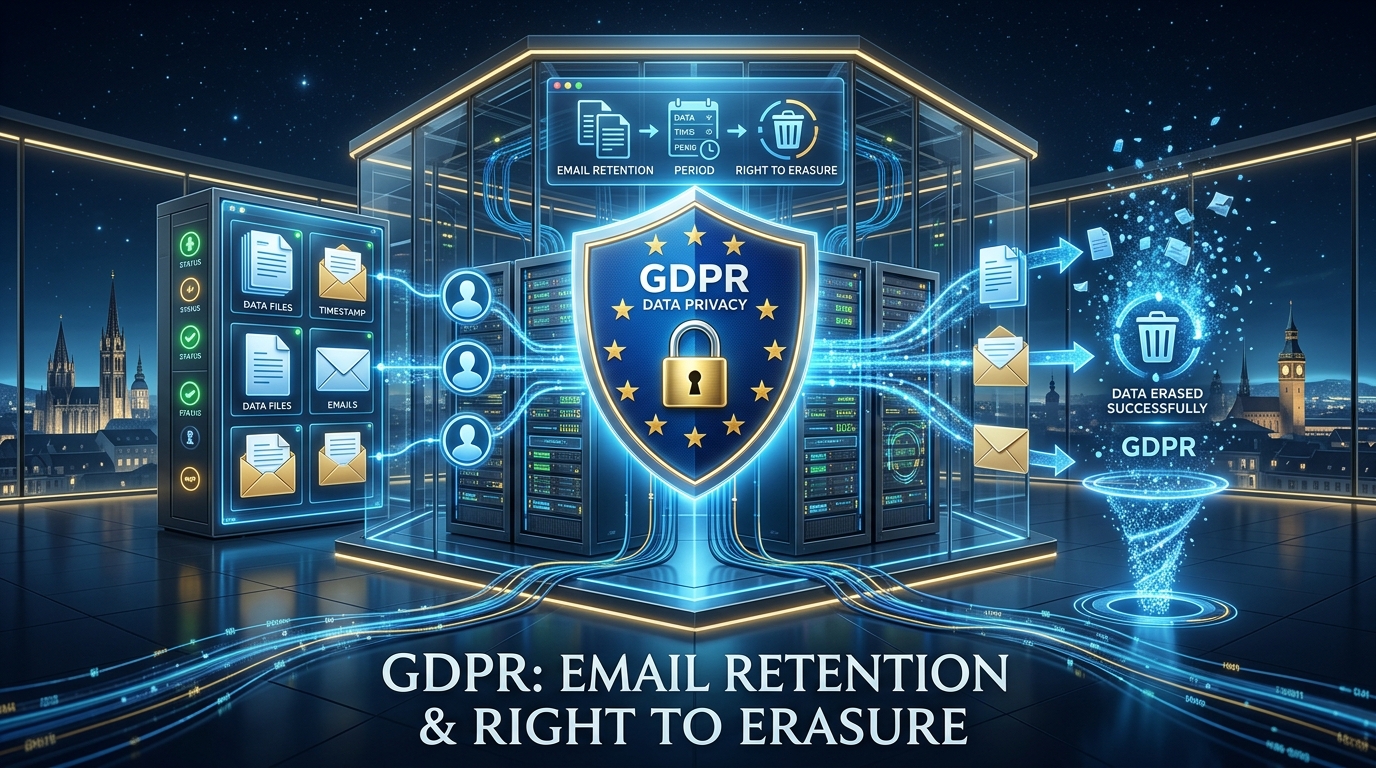
GDPR and Email Retention: Where 'Keep Everything' Conflicts With 'Delete on Request'
You probably know the situation: your organization has years of emails sitting across employee mailboxes, shared inboxes, archives, backups, and cloud storage. Some contain customer information. Some contain employee data. Others contain contracts, complaints, business decisions, or personal information that nobody remembers collecting in the first place.
Then a GDPR erasure request arrives.
Suddenly, the instruction to "keep everything" becomes much harder to defend.
Which emails contain the person's personal data? Which copies need to be considered? Does the information have to be deleted? What if the email is subject to a legal hold? What about backups? And how can the organization prove that it followed its retention and deletion policy consistently?
This is the real challenge behind GDPR email retention. It is not simply a question of how much storage an organization has. It is a question of whether the organization can justify what it keeps, why it keeps it, how long it keeps it, and what happens when someone asks for it to be erased.
What Does GDPR Say About Email Retention?
GDPR does not provide a universal rule saying that business emails must be deleted after a particular number of days or years.
Instead, Article 5 establishes the storage limitation principle: personal data should be kept in a form that permits identification of individuals for no longer than is necessary for the purposes for which the data is processed, subject to specific exceptions. The same article also establishes accountability, meaning organizations must be able to demonstrate compliance with these principles.
That creates a fundamental problem for organizations that use a blanket retention strategy:
Keeping everything forever is difficult to reconcile with a requirement to justify how long personal data needs to be retained.
The question is therefore not simply whether an organization can technically retain email.
The question is whether it has a defensible reason for doing so.
Why "Keep Everything" Creates a GDPR Problem
Many enterprises historically approached email retention from a risk-management perspective:
- Keep every email.
- Keep every attachment.
- Keep every archive.
- Keep everything in case it is needed later.
That approach may appear attractive to IT teams because storage is easier than deciding what should be deleted.
But GDPR introduces a different consideration.
If an organization no longer needs personal data for the purpose for which it was collected or processed, continuing to retain it indefinitely can create unnecessary privacy and security exposure. The ICO's guidance on storage limitation similarly emphasizes that organizations should be able to justify how long they retain personal data and should regularly review, erase, or anonymize data that is no longer required.
Every additional year of unnecessary retention can mean more data to:
- Search during a data subject request
- Protect against unauthorized access
- Review during an investigation
- Include in a data breach assessment
- Classify and govern
- Delete when retention is no longer justified
For an enterprise with millions of emails, the problem quickly becomes operational rather than theoretical.
Does the GDPR Right to Erasure Mean Every Email Must Be Deleted?
No.
This is another important distinction.
Article 17 of the GDPR establishes the right to erasure, often called the "right to be forgotten." Under certain circumstances, an individual can request that personal data concerning them be erased without undue delay. One of the grounds is that the personal data are no longer necessary for the purposes for which they were collected or processed.
However, the right to erasure is not absolute.
Article 17 includes exceptions. For example, erasure does not apply to the extent that processing is necessary for compliance with a legal obligation or for the establishment, exercise, or defence of legal claims. Other exceptions also exist.
This is where email retention becomes a governance problem.
An organization cannot simply operate with either of these two rules:
"Delete everything when someone asks."
or
"Keep everything because we might need it someday."
It needs a controlled process that determines which rule applies to which information.
GDPR Email Retention vs. Right to Erasure
The Hidden Problem: One Email Can Exist in Many Places
Deleting an email from an employee's inbox does not necessarily mean the organization's copies of that personal data have disappeared.
The same communication could potentially exist in:
- The sender's mailbox
- The recipient's mailbox
- A shared mailbox
- An email archive
- An eDiscovery or compliance repository
- Exported files
- Security or monitoring systems
- Backups
- Third-party systems
- Attachments stored elsewhere
This creates a difficult question during an erasure request:
Where does the organization actually have control over the personal data?
A retention strategy that only considers the primary mailbox may therefore provide an incomplete picture.
The organization needs to understand its information flows and identify where email data is being retained, copied, processed, or referenced.
What Happens When an Erasure Request Meets a Legal Hold?
This is one of the most important scenarios for enterprise email governance.
Imagine an employee or customer submits a GDPR erasure request. At approximately the same time, the organization becomes involved in litigation involving communications that include that person's information.
Deleting relevant information simply because an erasure request was received could create a different legal problem.
GDPR itself recognizes an exception where processing is necessary for the establishment, exercise, or defence of legal claims.
The practical requirement is therefore not "delete everything immediately."
It is to determine:
- What personal data is involved?
- Why is it being retained?
- What legal basis or obligation supports continued processing?
- Is the information subject to a legal hold?
- Does an Article 17 exception apply?
- Which systems contain the information?
- What should be deleted, restricted, or retained?
- Can the organization demonstrate how the decision was made?
Why Manual Email Retention Processes Break Down
For a small organization with a limited number of mailboxes, manually reviewing email may appear manageable.
For an enterprise, it quickly becomes difficult.
Consider an organization with thousands of employees and multiple years of email history.
A single data subject request could potentially require teams to identify relevant information across multiple systems while simultaneously determining whether particular records are subject to retention obligations, legal holds, or other exceptions.
The challenge is not simply finding an email.
It is understanding the context surrounding the email.
A manual process may also make it difficult to demonstrate that similar requests were handled consistently.
What a GDPR-Compliant Email Governance Approach Looks Like
A stronger approach combines retention policies with classification, monitoring, workflow automation, and auditability.
A simplified governance process can look like this:
Discover → Classify → Apply Retention Policy → Identify Exceptions → Execute Action → Audit
1. Discover
Identify where organizational email data exists and which systems may contain personal information.
2. Classify
Determine what type of information the communication contains and why it may be subject to a particular policy.
For example, an organization may distinguish between:
- Customer communications
- Employee communications
- Contracts
- Financial information
- Health-related information
- Legal communications
- General business correspondence
3. Apply Retention Policy
Retention periods should reflect the organization's documented purposes, legal obligations, regulatory requirements, and business needs.
The ICO recommends that organizations establish and document standard retention periods wherever possible and periodically review information to determine whether it should be erased or anonymized.
4. Identify Exceptions
Not every record should automatically be deleted when a standard retention period expires or when an erasure request arrives.
Legal obligations, legal claims, and other applicable exceptions may require different treatment.
5. Execute the Appropriate Action
The resulting action might be:
- Delete
- Anonymize
- Retain
- Restrict processing
- Place under legal hold
- Escalate for review
6. Audit
Record the relevant decision and action so the organization can demonstrate that its process was followed.
Where AI Can Help With Email Retention Governance
AI does not replace a legal team's judgment or an organization's documented retention policy.
But it can help organizations manage the scale and complexity of email.
Traditional rules may look for specific keywords, addresses, attachment types, or patterns.
AI-assisted classification can add contextual understanding.
For example, an email may not contain an obvious keyword such as "passport" or "medical record," but its surrounding content and context may indicate that it contains sensitive personal information.
This can help organizations create more intelligent workflows:
Detect → Understand → Classify → Apply Policy → Route → Govern
The important point is that AI should support a documented governance framework rather than become the governance framework itself.
How MailGovern Can Support GDPR Email Governance
MailGovern approaches enterprise email as a communication that can be classified, monitored, routed, governed, and audited—rather than simply stored.
For organizations dealing with GDPR-sensitive communications, this distinction can be valuable.
Context-Aware Classification
MailGovern can use AI-assisted classification and organizational rules to help identify the nature of email communications and determine which policies may apply.
Policy-Driven Workflows
Instead of relying entirely on manual review, organizations can build workflows around defined email governance policies.
Outbound Email Monitoring
Monitoring outbound communications can help organizations identify potentially sensitive information before it becomes an unmanaged data-distribution problem.
For organizations looking to strengthen their email governance strategy, this provides a layer between email activity and organizational policy.
Auditability
When an email is classified or a policy action occurs, governance requires more than the final outcome. Teams may also need visibility into what happened and why.
An audit trail can help security, compliance, and IT teams investigate policy decisions and demonstrate operational control.
A Practical Example: A GDPR Erasure Request
Consider a customer who has communicated with an organization by email for several years.
The customer submits a request for erasure.
A basic process might tell an administrator to search the mailbox and delete matching emails.
A governance-driven process asks more questions.
- Where does the customer's personal data exist?
- Which communications are relevant?
- Which records are still required for legitimate purposes?
- Are any communications subject to legal or regulatory retention?
- Are any records covered by a legal hold?
- Which data can be deleted?
- Which data must remain restricted or retained?
- Was the decision documented?
This approach does not treat GDPR as a simple "delete button."
It treats data retention as a controlled business process.
Retention Policy vs. "Keep Everything"
What Should Organizations Prove About Email Retention?
For enterprise compliance teams, the strongest question is not simply whether an organization has a retention policy.
It should be able to demonstrate that the policy actually operates in practice.
That means being able to answer questions such as:
- What categories of personal information are retained?
- Why are they retained?
- How long are they retained?
- Who approved the retention period?
- What happens when the retention period expires?
- How are exceptions handled?
- How are erasure requests evaluated?
- How are legal holds handled?
- How are deletion decisions recorded?
- Can the organization demonstrate that its process was followed?
This is where GDPR moves beyond a privacy-policy exercise.
It becomes an operational governance requirement.
Key Takeaways
- GDPR does not establish one universal email retention period.
- The storage limitation principle requires organizations to justify how long personal data is retained.
- The right to erasure does not mean every piece of personal data must always be deleted.
- Legal obligations and legal claims can create exceptions to erasure.
- Deleting an email from a mailbox does not necessarily eliminate every copy of the personal data.
- Large organizations need repeatable processes for classification, retention, erasure, exceptions, and auditability.
- AI can assist with email classification and workflow automation, but it should operate within a documented governance framework.
- Email retention is not the same as email governance.
Conclusion
The conflict between "keep everything" and "delete on request" is not really a conflict between two storage settings.
It is a conflict between two fundamentally different approaches to information management.
One approach treats email as something that should simply be preserved.
The other treats email as business data that needs a defined purpose, policy, lifecycle, and governance process.
GDPR pushes organizations toward the second model.
The goal is not to delete information blindly. Nor is it to retain everything indefinitely.
The goal is to know what you have, why you have it, how long you need it, when it can be deleted, when it must be retained, and how you can demonstrate that those decisions were made consistently.
For enterprises managing large volumes of email, that is the difference between having an archive and having an email governance strategy.
MailGovern helps organizations move from simply storing email to controlling, automating, and governing business communication.
Frequently Asked Questions
Does GDPR require companies to delete emails after a specific period?
No. GDPR does not establish one universal retention period for business emails. Instead, the storage limitation principle requires organizations to avoid keeping personal data longer than necessary for the purposes for which it is processed, subject to applicable exceptions.
Does GDPR require all emails containing personal data to be deleted on request?
No. Individuals can have a right to erasure under Article 17, but that right is subject to exceptions. For example, continued processing may be necessary to comply with a legal obligation or to establish, exercise, or defend legal claims.
How long should companies retain emails under GDPR?
There is no universal GDPR email-retention period. Organizations should determine retention periods based on the purpose for processing, applicable legal and regulatory requirements, business requirements, and relevant exceptions, and should be able to justify those periods.
What is the GDPR storage limitation principle?
The storage limitation principle means personal data should be kept in an identifiable form for no longer than necessary for the purposes for which it is processed, subject to specific exceptions. Organizations should be able to demonstrate compliance with this principle.
What happens when a GDPR erasure request conflicts with a legal hold?
The organization needs to evaluate the applicable legal circumstances. GDPR provides an exception to erasure where processing is necessary for the establishment, exercise, or defence of legal claims. The organization should therefore avoid treating every erasure request as an automatic deletion instruction.
Why is email governance important for GDPR compliance?
Email governance can help organizations manage classification, retention policies, monitoring, workflows, exceptions, and auditability. This can make it easier to apply privacy policies consistently across large volumes of business communication.
Can AI help organizations manage GDPR-related email retention?
Yes. AI can assist with classifying communications, identifying potentially sensitive information, and triggering governance workflows. However, AI should support documented policies and human oversight rather than independently determine an organization's legal obligations.
How can MailGovern help with email governance?
MailGovern provides enterprise email governance capabilities designed to help organizations classify, monitor, route, control, and audit email communications. This can support organizations that need more than simple mailbox retention and want policy-driven control over business email.