For a financial services firm, an email is rarely "just an email." A message from an advisor to a client can contain an investment recommendation. A trader's communication can relate to an order. A compliance officer may send instructions about a regulatory issue. An executive's email may become relevant to an investigation, audit, or legal proceeding.
Now imagine a regulator asks your organization to produce a specific communication from three years ago.
The question is no longer whether your employees still have the message in Outlook.
The real questions become: Was the communication required to be retained? Was it captured from an approved channel? Was the original preserved appropriately? Can it be located quickly? Can the organization demonstrate that the record was not improperly altered or deleted?
This is why email archiving for financial services is fundamentally different from ordinary email backup.
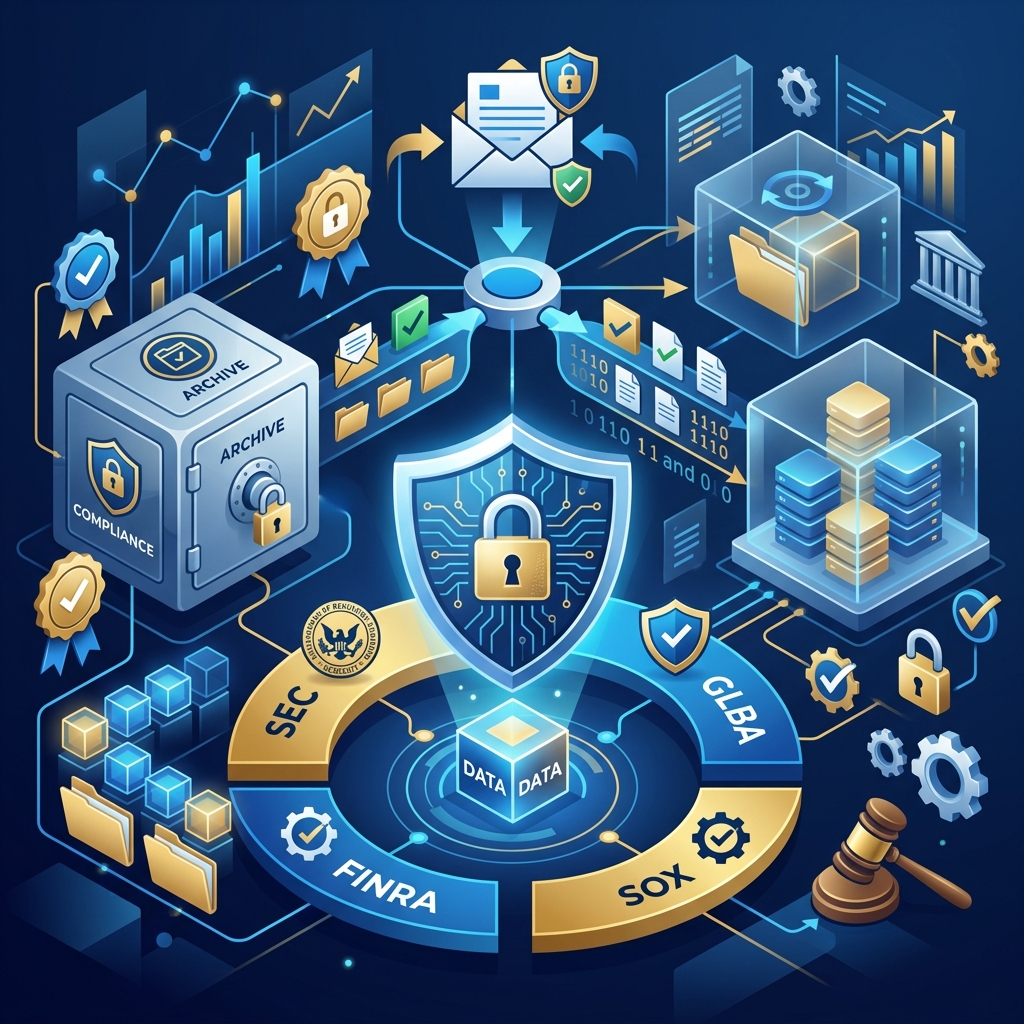
SEC, FINRA, SOX, and GLBA requirements create overlapping but different obligations around records, communications, customer information, security, supervision, and auditability. The exact requirement depends on the type of financial institution, the activity involved, and the applicable rule.
The goal is therefore not simply to "keep emails for seven years."
The goal is to build a defensible system for capturing, preserving, governing, retrieving, and auditing regulated communications.
What Is Email Archiving in Financial Services?
Financial-services email archiving is the controlled preservation of business communications and associated records so that authorized personnel can retrieve them when required for regulatory examinations, audits, investigations, litigation, compliance reviews, or internal supervision.
A modern archive may need to address more than the email body.
Depending on the applicable rule and record type, relevant information can include:
- Email messages
- Attachments
- Recipients and senders
- Dates and timestamps
- Approvals
- Communications with customers
- Internal communications
- Electronic communications conducted through approved channels
- Records associated with transactions or recommendations
- Audit and supervisory information
The important distinction is that backup and compliance archiving are not necessarily the same thing.
A backup is primarily designed to help restore systems and data.
An archive designed for regulatory recordkeeping must address the applicable requirements for preservation, accessibility, retrieval, integrity, and supervision.
Why Financial Firms Cannot Treat Every Email the Same Way
One of the biggest mistakes in regulatory email retention is assuming that every financial-services organization has one universal retention period.
It does not.
Different rules apply to different entities and different categories of records.
This distinction matters because a compliance strategy built around one generic retention number can easily miss the actual requirement.
SEC Email Recordkeeping Requirements
The SEC's recordkeeping requirements vary depending on the type of regulated entity and the record involved.
For broker-dealers, Exchange Act Rule 17a-4 establishes preservation requirements for records required under Rule 17a-3. Certain records must be preserved for at least six years, while other categories—including certain communications relating to the firm's broker-dealer business—are subject to a three-year requirement. ([SEC]([https://www.sec.gov/files/rules/final/34-44992.htm](https://www.sec.gov/files/rules/final/34-44992.htm)))
The SEC's rules therefore should not be simplified to "all financial emails must be kept for six years."
For example, Rule 17a-4(b)(4) addresses originals of communications received and copies of communications sent by a broker-dealer relating to its business, including inter-office communications. ([SEC]([https://www.sec.gov/files/rules/final/34-44992.htm](https://www.sec.gov/files/rules/final/34-44992.htm)))
The technology used to preserve those records also matters.
The SEC amended Rule 17a-4 to make electronic recordkeeping more technology-neutral. Broker-dealers can use an electronic recordkeeping system meeting an audit-trail requirement as an alternative to the traditional WORM approach. The audit-trail approach must permit reconstruction of the original record if it is modified or deleted. ([SEC]([https://www.sec.gov/investment/amendments-electronic-recordkeeping-requirements-broker-dealers](https://www.sec.gov/investment/amendments-electronic-recordkeeping-requirements-broker-dealers)))
That creates an important architectural requirement:
A compliant archive must preserve not only the content, but also the integrity and reconstructability required by the applicable rule.
FINRA Email Retention and Supervision
FINRA adds another layer for broker-dealers.
FINRA Rule 4511 generally requires firms to preserve books and records in accordance with applicable SEC recordkeeping requirements and other applicable regulations. FINRA's rules also address the preservation of communications and records associated with the firm's business. ([FINRA]([https://www.finra.org/sites/default/files/Rules_Reference_Guide.pdf](https://www.finra.org/sites/default/files/Rules_Reference_Guide.pdf)))
That means financial firms cannot think about archiving purely as a storage problem.
They also need to think about supervision and review.
FINRA's recent regulatory oversight materials specifically identify failures involving electronic communications that were not retained, archived, or reviewed when conducted through firm-approved channels. ([FINRA]([https://www.finra.org/sites/default/files/2025-12/2026-annual-regulatory-oversight-report.pdf](https://www.finra.org/sites/default/files/2025-12/2026-annual-regulatory-oversight-report.pdf)))
This highlights a critical point:
Capturing communications is only one part of the compliance process.
Financial firms also need controls around approved communication channels, supervisory review, monitoring, and the ability to retrieve records when required.
What SOX Means for Email Retention
The Sarbanes-Oxley Act of 2002 introduced significant requirements around corporate financial reporting, internal controls, and audit-related records.
For email archiving, Section 802 is particularly relevant to records associated with audits and reviews.
SEC Rule 2-06 requires accounting firms to retain records relevant to audits or reviews of an issuer's or registered investment company's financial statements. The records can include workpapers, memoranda, correspondence, communications, electronic records, and other documents that contain conclusions, opinions, analyses, or financial data related to the audit or review.
The required retention period under Rule 2-06 is seven years after the auditor concludes the audit or review. ([SEC]([https://www.sec.gov/newsroom/press-releases/2003-11-sec-adopts-rules-retention-records-relevant-audits-reviews](https://www.sec.gov/newsroom/press-releases/2003-11-sec-adopts-rules-retention-records-relevant-audits-reviews)))
That is an important distinction.
SOX does not simply mean that every employee email at a public company must automatically be archived for seven years.
Rather, specific records relevant to audits and reviews can fall within the applicable retention requirement.
Organizations therefore need to understand what constitutes a relevant record and how those records are captured and preserved.
What GLBA Means for Financial Email
The Gramm-Leach-Bliley Act takes a different approach.
GLBA requires financial institutions to protect the privacy and security of customers' nonpublic personal information. The FTC's Safeguards Rule requires covered financial institutions under FTC jurisdiction to develop, implement, and maintain an information security program with administrative, technical, and physical safeguards designed to protect customer information. ([FTC]([https://www.ftc.gov/legal-library/browse/rules/safeguards-rule](https://www.ftc.gov/legal-library/browse/rules/safeguards-rule)))
The FTC explains that customer information under the Safeguards Rule includes records containing nonpublic personal information about customers, whether maintained in paper, electronic, or other forms. ([FTC]([https://www.ftc.gov/business-guidance/resources/ftc-safeguards-rule-what-your-business-needs-know](https://www.ftc.gov/business-guidance/resources/ftc-safeguards-rule-what-your-business-needs-know)))
This means financial email can become part of the broader information-security picture when it contains customer information.
Examples can include:
- Account information
- Financial information
- Identity information
- Customer correspondence
- Transaction information
- Documents containing nonpublic personal information
GLBA should therefore not be reduced to an "email retention rule."
Its relevance to email is largely about protecting sensitive customer information and implementing an appropriate information security program.
SEC vs. FINRA vs. SOX vs. GLBA: What Is the Difference?
Why Email Archiving Alone Is Not Enough
Suppose a broker-dealer archives every email generated by its employees.
That sounds comprehensive.
But consider what happens when a regulator asks:
- Was this communication sent through an approved channel?
- Was it retained according to the applicable recordkeeping requirement?
- Could the original record be reconstructed?
- Was the communication subject to supervisory review?
- Was the employee using another communication channel?
- Was an attachment included?
- Can the firm produce the record quickly?
- Can the firm demonstrate how its retention policy was applied?
An archive answers some of these questions.
A broader governance system can help answer many more.
This is why financial-services organizations increasingly need to think beyond email storage and toward email governance.
The Approved-Channel Problem
One of the biggest challenges in regulated financial communications is that employees do not always communicate through the channels compliance teams expect.
Email may be captured correctly while other electronic communications are not.
FINRA's 2026 Annual Regulatory Oversight Report specifically highlights failures involving non-email electronic communications conducted through firm-approved channels that were not retained, archived, and reviewed. ([FINRA]([https://www.finra.org/sites/default/files/2025-12/2026-annual-regulatory-oversight-report.pdf](https://www.finra.org/sites/default/files/2025-12/2026-annual-regulatory-oversight-report.pdf)))
This creates a governance question:
How do you know where regulated business communication is happening?
A strong compliance program therefore needs policies around approved communication channels, monitoring, supervision, and recordkeeping—not simply an email archive.
What a Financial Services Email Governance Workflow Looks Like
A practical governance model can be represented as:
Capture → Classify → Apply Policy → Preserve → Monitor → Audit
1. Capture
Identify and capture communications that fall within the organization's applicable recordkeeping requirements.
2. Classify
Determine what type of communication it is.
For example:
- Investment recommendation
- Trade-related communication
- Customer correspondence
- Marketing communication
- Internal compliance communication
- Legal communication
- Financial reporting communication
3. Apply Policy
Determine which retention, supervision, security, or workflow policy applies to the communication.
4. Preserve
Maintain the applicable record in a manner consistent with the relevant regulatory requirements.
5. Monitor
Enable compliance teams to identify policy violations, unusual activity, or communications that require review.
6. Audit
Maintain appropriate evidence showing what happened, which policy applied, and how the communication was handled.
Where AI Can Improve Financial Email Governance
Traditional email rules often depend on simple conditions:
- Sender
- Recipient
- Domain
- Keyword
- Attachment type
- Subject line
These controls remain useful, but financial communications can be highly contextual.
Consider:
"Based on our discussion, I recommend moving 20% of the portfolio into the fund we discussed."
The compliance significance of this communication is not necessarily determined by a single keyword.
Understanding its context can be useful for classification and workflow decisions.
AI-assisted email classification can help organizations categorize communications based on topic, intent, urgency, sensitivity, or organizational rules.
A governance workflow can then move from:
Detect → Classify → Route → Govern → Audit
AI should not independently determine what the law requires. Instead, it can support the organization's documented policies by helping identify communications and route them into the appropriate governance workflow.
How MailGovern Can Support Financial Email Governance
MailGovern is designed around the idea that enterprise email should not simply be stored—it should be understood, controlled, automated, and governed.
For financial-services organizations, this model can support several areas of the compliance workflow.
AI-Powered Email Classification
MailGovern can help classify email based on organizational criteria such as topic, urgency, compliance relevance, or custom rules.
This creates a foundation for applying different governance workflows to different categories of communication.
outbound email monitoring
Financial firms need visibility into what employees are sending outside the organization.
Outbound monitoring can help identify communications that require additional review or policy enforcement before they become a regulatory or security problem.
Policy-Based workflow automation
Instead of requiring compliance teams to manually inspect every communication, organizations can define workflows that determine what should happen when a particular type of email is detected.
Depending on the organization's policies, a workflow could trigger routing, review, escalation, blocking, or another controlled action.
Auditability
Compliance is not only about what the system did. It is also about whether the organization can demonstrate what happened.
An appropriate audit trail can provide visibility into relevant classification and policy actions, helping teams investigate communications and demonstrate operational control.
A Practical Example: An Investment Recommendation Email
Consider an investment adviser sending an email to a prospective or existing client.
The email includes an investment recommendation and an attachment containing supporting information.
A governance workflow could operate as follows:
- Capture: The communication enters the organization's controlled email environment.
- Classify: The system identifies the message as an investment-related communication.
- Evaluate: Relevant compliance and retention policies are applied.
- Preserve: The communication is retained according to the applicable recordkeeping requirements.
- Monitor: The communication becomes available for appropriate supervisory review.
- Audit: Relevant governance events are recorded for future investigation or examination.
The objective is not to automate legal judgment.
The objective is to make the organization's documented compliance process more consistent, scalable, and auditable.
What Financial Firms Should Look for in an Email Archiving Solution
The Biggest Mistake: Treating Compliance as a Retention Number
Financial organizations often ask:
"How many years do we need to keep our emails?"
That is an important question—but it is only the beginning.
The more useful questions are:
- Which communications are regulated?
- Which regulatory framework applies?
- Which record category does the communication belong to?
- What retention period applies?
- How is the record preserved?
- Can the original be reconstructed where required?
- Is the communication subject to supervisory review?
- Are employees using approved communication channels?
- Can the organization retrieve the record promptly?
- Can compliance teams demonstrate how the policy was enforced?
This is the difference between archiving emails and governing regulated communications.
Key Takeaways
- SEC, FINRA, SOX, and GLBA do not create one universal email-retention rule.
- SEC broker-dealer requirements include different preservation periods for different record categories, including certain communications. ([SEC]([https://www.sec.gov/files/rules/final/34-44992.htm](https://www.sec.gov/files/rules/final/34-44992.htm)))
- FINRA Rule 4511 works alongside applicable SEC recordkeeping requirements and firms also need appropriate supervisory controls. ([FINRA]([https://www.finra.org/sites/default/files/Rules_Reference_Guide.pdf](https://www.finra.org/sites/default/files/Rules_Reference_Guide.pdf)))
- SOX-related audit and review records can be subject to a seven-year retention requirement under SEC Rule 2-06. ([SEC]([https://www.sec.gov/newsroom/press-releases/2003-11-sec-adopts-rules-retention-records-relevant-audits-reviews](https://www.sec.gov/newsroom/press-releases/2003-11-sec-adopts-rules-retention-records-relevant-audits-reviews)))
- GLBA focuses heavily on protecting customer financial information through appropriate safeguards rather than prescribing one universal email retention period. ([FTC]([https://www.ftc.gov/legal-library/browse/rules/safeguards-rule](https://www.ftc.gov/legal-library/browse/rules/safeguards-rule)))
- Electronic recordkeeping may need to address integrity, accessibility, and reconstructability—not simply storage.
- Financial firms should govern approved communication channels, not only email.
- AI can assist with classification and workflow automation, but documented compliance policies remain the foundation.
- Effective financial email archiving is ultimately an information-governance problem, not merely a storage problem.
Conclusion
Financial-services email compliance cannot be reduced to a single number such as three, five, six, or seven years.
Different rules apply to different records, entities, and activities.
The SEC governs specific books and records and communications requirements. FINRA adds recordkeeping and supervisory expectations for member firms. SOX introduces important requirements around audit and financial-reporting records. GLBA focuses on safeguarding customer financial information.
The common thread is control.
Financial firms need to know what communications they are required to preserve, how those communications are protected, how they can be retrieved, and how the organization can demonstrate that its policies actually operate.
That is why modern compliance programs should think beyond an archive.
Capture the communication. Understand what it represents. Apply the right policy. Preserve the appropriate record. Monitor the workflow. Maintain the evidence.
That is email governance.
And for financial organizations managing high volumes of regulated communication, it can be the difference between simply having years of email stored somewhere and having a defensible system for managing regulated communications.
Frequently Asked Questions
How long do financial institutions need to retain emails?
There is no single retention period that applies to every financial-services email. Requirements depend on the type of organization, the communication or record involved, and the applicable SEC, FINRA, SOX, or other regulatory requirements. For example, certain broker-dealer communications under SEC Rule 17a-4 are subject to a three-year preservation period, while certain other broker-dealer records are subject to six years. ([SEC]([https://www.sec.gov/files/rules/final/34-44992.htm](https://www.sec.gov/files/rules/final/34-44992.htm)))
Does SEC Rule 17a-4 require financial firms to archive emails?
For broker-dealers, Rule 17a-4 includes requirements to preserve certain communications and other records. The exact requirement depends on the applicable record category. The SEC has also established technology-neutral electronic recordkeeping requirements, including an audit-trail alternative to the traditional WORM approach. ([SEC]([https://www.sec.gov/investment/amendments-electronic-recordkeeping-requirements-broker-dealers](https://www.sec.gov/investment/amendments-electronic-recordkeeping-requirements-broker-dealers)))
How long does FINRA require firms to keep communications?
FINRA Rule 4511 works with applicable SEC recordkeeping requirements, so the applicable retention period depends on the type of record and the rules governing the member firm. Firms should not assume that every communication has the same retention period.
Does SOX require all company emails to be retained for seven years?
No. The seven-year requirement under SEC Rule 2-06 applies to records relevant to audits or reviews of an issuer's or registered investment company's financial statements that fall within the rule. It should not be interpreted as a blanket seven-year requirement for every company email. ([SEC]([https://www.sec.gov/newsroom/press-releases/2003-11-sec-adopts-rules-retention-records-relevant-audits-reviews](https://www.sec.gov/newsroom/press-releases/2003-11-sec-adopts-rules-retention-records-relevant-audits-reviews)))
Does GLBA require financial institutions to archive emails?
GLBA is primarily concerned with protecting consumers' nonpublic personal information. The FTC Safeguards Rule requires covered financial institutions under FTC jurisdiction to maintain an information security program with appropriate administrative, technical, and physical safeguards. It is not a universal email-retention rule. ([FTC]([https://www.ftc.gov/business-guidance/resources/ftc-safeguards-rule-what-your-business-needs-know](https://www.ftc.gov/business-guidance/resources/ftc-safeguards-rule-what-your-business-needs-know)))
What is the difference between email backup and regulatory email archiving?
Email backup is primarily intended to restore data after loss or system failure. Regulatory archiving is designed to preserve applicable business records and communications in accordance with regulatory requirements, including appropriate accessibility, integrity, retention, and retrieval controls.
Why is email classification important for financial compliance?
Different communications can have different regulatory and business significance. Classification can help organizations identify investment recommendations, customer correspondence, transaction-related messages, marketing communications, and other categories so the appropriate policies and workflows can be applied.
Can AI help financial institutions with email archiving?
AI can assist with classifying communications, identifying context, detecting potentially sensitive content, and routing messages into appropriate governance workflows. It should support, rather than replace, the organization's documented compliance policies and human oversight.
How can MailGovern help financial services organizations?
MailGovern provides enterprise email governance capabilities designed to help organizations classify, monitor, route, control, automate, and audit business email. For financial-services organizations, this can complement existing retention and compliance systems by adding policy-driven governance and visibility around email activity.