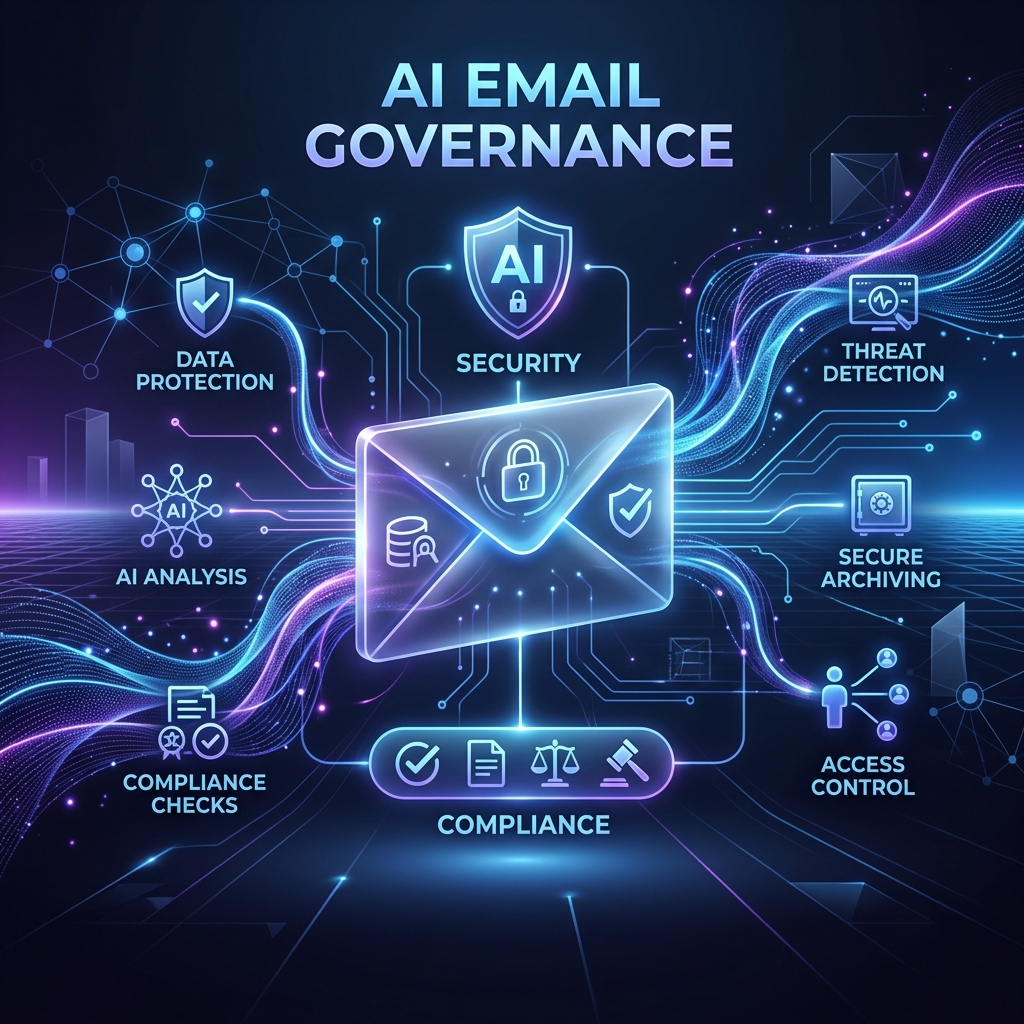
Email is still one of the primary communication channels for modern enterprises. Employees use email to exchange customer information, contracts, financial documents, confidential files, intellectual property, and other business-critical information every day.
That creates a governance challenge.
Traditional email security solutions are primarily designed to protect organizations from threats such as phishing, malware, spam, and malicious links. These controls remain important, but they don't necessarily answer another critical question:
Should this email be sent in the first place?
An employee can send a legitimate email from a legitimate account to a legitimate recipient and still accidentally expose sensitive information.
This is where AI email governance can provide an additional layer of control.
AI can help organizations analyze email content, classify communications, identify potentially sensitive information, monitor outbound messages, evaluate policies, and trigger actions based on organizational requirements.
Instead of relying only on static rules or manual reviews, enterprises can combine AI-driven analysis with configurable policies to create a more intelligent approach to email security and compliance.
What Is AI Email Governance?
AI email governance is the use of artificial intelligence to analyze, classify, monitor, and control enterprise email according to an organization's security, compliance, and business policies.
An AI email governance platform can evaluate factors such as:
- Email content
- Attachments
- Sender and recipient
- Internal or external communication
- Sensitive information
- Organizational policies
- Communication context
- Required workflows
The objective is not simply to identify whether an email is malicious.
It is to help organizations determine what an email contains, whether it complies with organizational policies, and what should happen next.
For example, if an employee attempts to send a confidential customer document to an unauthorized external recipient, an AI-enabled governance system could identify the sensitive content, evaluate the recipient against the organization's policy, and trigger an appropriate action.
Depending on the configured policy, that action could include allowing, flagging, routing for review, or blocking the email.
How Does AI Email Governance Work?
AI email governance generally combines AI-based analysis with configurable policies and automated workflows.
A simplified workflow looks like this:
Email → AI Analysis → Classification → Policy Evaluation → Decision → Action → Audit
1. Email Analysis
The system analyzes relevant information associated with an email, such as the message body, attachments, sender, and recipient.
2. AI Email Classification
The email is classified according to its content and context.
For example, the system may identify a message as containing:
- Confidential business information
- Customer information
- Financial information
- Legal information
- Restricted attachments
- Internal communication
- Compliance-sensitive content
3. Policy Evaluation
The classification and other relevant signals are compared against organizational policies.
For example:
Confidential customer information must not be sent to unauthorized external recipients.
4. Decision
The organization can configure what should happen when a policy condition is met.
5. Action
Depending on the policy, the system may:
- Allow the email
- Flag the email
- Hold it for review
- Route it for approval
- Block it
- Trigger another workflow
6. Audit
The event can be recorded so authorized teams can investigate the decision and maintain visibility into email governance activity.
This approach connects AI analysis with enforceable organizational policies.
AI Email Security vs. AI Email Governance
AI email security and AI email governance overlap, but they address different aspects of enterprise email protection.
AI email security generally focuses on identifying and responding to security threats.
For example:
- Phishing
- Malware
- Suspicious links
- Malicious attachments
- Account-related threats
AI email governance extends the focus to how legitimate business communications are handled.
For example:
- Can this employee send this information externally?
- Does the attachment contain restricted information?
- Is this recipient authorized?
- Does the message violate an internal policy?
- Should the message require approval?
- Should the email be blocked before leaving the organization?
In practice, organizations may use security and governance controls together rather than treating them as competing approaches.
| Capability | AI Email Governance | Traditional Email Security |
|---|---|---|
| Spam protection | May integrate with existing controls | Common |
| Malware detection | May complement existing controls | Common |
| Phishing detection | May complement existing controls | Common |
| Email classification | AI-assisted | Varies |
| Content analysis | AI + configurable rules | Rule-based or limited |
| Outbound monitoring | Core governance capability | Varies |
| Policy enforcement | AI-assisted + policy-based | Rule-based |
| Sensitive information detection | AI + rules | DLP/rules |
| Automated actions | Configurable | Common |
| Workflow routing | Can be policy-driven | Varies |
| Audit trail | Important governance component | Common in enterprise tools |
The important distinction is that email security asks whether a message presents a threat, while email governance can also ask whether the communication complies with organizational policy.
AI Email Classification: Understanding What Emails Contain
One of the core capabilities behind intelligent email governance is AI email classification.
Enterprises send enormous volumes of email every day. Treating every message identically makes it difficult to identify which communications require additional attention.
AI-based classification can help organize emails into meaningful categories.
For example:
| Classification | Example |
|---|---|
| Confidential | Internal strategy document |
| Customer Information | Customer account details |
| Financial | Invoice or financial report |
| Legal | Contract or legal communication |
| Restricted | Sensitive company document |
| Internal | Employee-only communication |
| External | Communication with customers or partners |
The classification system can then be connected to organizational policies.
For example:
Classification: Confidential
Recipient: External
Policy: Confidential information requires authorization before external transmission
Action: Route for review
This is different from simply searching for one keyword.
The objective is to understand the type and context of the communication and connect that understanding to an organizational policy.
AI Email Monitoring for Enterprise Communications
Large enterprises may process thousands or millions of email communications across departments, locations, and business units.
Manually reviewing every message is not practical.
This is where AI email monitoring can help organizations identify communications that may require attention.
Depending on the organization's policies, monitoring can help identify:
- Sensitive information
- Restricted attachments
- Unauthorized recipients
- Policy violations
- Unusual outbound communications
- Compliance-sensitive messages
- High-risk communications
The purpose of AI email monitoring isn't necessarily to have humans inspect every email.
Instead, AI can help organizations identify and prioritize communications that deserve further attention.
For example, a security or compliance team could focus on emails that meet predefined risk or policy conditions rather than manually reviewing the organization's entire email volume.
AI Outbound Email Monitoring: Controlling What Leaves the Organization
Inbound email threats receive significant attention, but outbound communication can create another important risk.
Employees regularly send information to:
- Customers
- Vendors
- Partners
- Consultants
- Contractors
- External organizations
An accidental attachment or unauthorized recipient can expose information outside the organization's intended boundaries.
AI outbound email monitoring can help organizations examine outgoing communications before they leave the organization.
Consider this scenario.
An employee prepares an email containing a spreadsheet with customer information and sends it to an external personal email address.
An AI-enabled email governance workflow could:
- Analyze the email and attachment.
- Identify potentially sensitive customer information.
- Identify the recipient as external.
- Evaluate the message against the organization's outbound email policy.
- Determine the configured action.
- Allow, flag, route, or block the email.
- Record the event for authorized investigation.
The exact action depends on the organization's policies and configuration.
The important concept is that outbound email can become a controlled business process rather than an unmanaged communication channel.
AI Email Compliance: Turning Policies Into Practical Controls
Compliance requirements often involve how sensitive information is collected, accessed, shared, stored, and protected.
Email can be part of that information flow.
Organizations may establish internal policies such as:
Customer information should not be sent to unauthorized external recipients.
Or:
Confidential documents require approval before external transmission.
Creating such policies is only the first step.
The organization also needs a way to consistently apply them.
This is where AI email compliance can support governance workflows.
An AI-enabled system can analyze email communications and identify conditions that may require additional controls.
For example:
Email content: Contains sensitive customer information
Recipient: External
Policy: External transmission requires authorization
Result: Email routed for review
This can help organizations move from documenting email policies to applying those policies consistently across their communication environment.
AI does not eliminate the need for compliance teams, legal guidance, or appropriate organizational controls. Instead, it can help automate parts of the process and provide greater visibility.
AI Email Policy Enforcement
A policy that exists only in an employee handbook cannot automatically prevent an email from being sent.
That is why AI email policy enforcement is an important part of modern email governance.
Consider a simple policy:
Employees must not send confidential company documents to personal email accounts.
Without technical enforcement, the organization may discover violations only after they occur.
With an AI-enabled governance workflow, the system can potentially:
Detect → Classify → Evaluate → Act
Detect
Identify relevant content or attachments.
Classify
Determine whether the information matches a defined category.
Evaluate
Check the email against the organization's policy.
Act
Trigger the configured action.
For example:
Confidential document + personal recipient → Block
Or:
Sensitive information + approved external recipient → Allow
Or:
Sensitive information + uncertain recipient → Review
This type of policy-based automation can help organizations apply controls consistently without requiring manual intervention for every email.
AI-Powered Email Security: Combining Intelligence With Rules
AI does not mean that organizations have to abandon traditional rules.
In many enterprise environments, the most practical approach is to combine AI-powered email security with configurable policies.
A traditional rule might say:
If an email contains a specific file type, block it.
That can be useful, but business communication isn't always that simple.
The same file type could be appropriate for one recipient and inappropriate for another.
Similarly, a particular keyword doesn't necessarily mean that an email contains sensitive information.
AI can provide an additional layer of analysis by evaluating the broader context.
For example:
Content + Attachment + Recipient + Policy + Context
can provide more information for a governance decision than any single signal alone.
The objective isn't to replace deterministic controls.
It is to combine intelligent analysis with clearly defined organizational policies.
A Real-World Example: Preventing Sensitive Data From Leaving an Organization
Imagine an enterprise employee receives a spreadsheet containing customer information.
The employee needs to send part of that information to an external partner.
The employee attaches the spreadsheet to an email and clicks Send.
A traditional workflow may simply deliver the email.
An AI email governance workflow could take a different approach.
Step 1: Analyze
The system analyzes the email and attachment.
Step 2: Classify
AI identifies information that may fall into a sensitive customer-data category.
Step 3: Evaluate the recipient
The recipient is outside the organization.
Step 4: Apply the policy
The organization has configured a policy requiring approval before sensitive customer information can be sent externally.
Step 5: Take action
The email could be held or routed for review according to the configured workflow.
Step 6: Record
The event can be captured in the organization's governance or audit process.
This example demonstrates how AI email classification, AI outbound email monitoring, AI email compliance, and AI email policy enforcement can work together.
Intelligent Email Governance for Modern Enterprises
The volume and complexity of enterprise email make manual governance increasingly difficult.
Organizations need visibility into communications without creating unnecessary friction for employees.
This is where intelligent email governance can provide a structured approach.
Instead of asking only:
"What emails were sent?"
Organizations can ask:
- What information was sent?
- Who received it?
- Was the information sensitive?
- Did the communication comply with policy?
- Did the message require review?
- Should the message have been blocked?
- What action was taken?
- Can the event be audited later?
These questions move email management beyond simple monitoring toward policy-driven governance.
What Should You Look for in an AI Email Governance Platform?
Organizations evaluating an AI email governance solution should consider more than the presence of the word "AI."
Look for capabilities that address actual governance requirements.
1. AI-Based Email Classification
Can the platform identify different types of email content and categorize messages according to organizational requirements?
2. Outbound Email Monitoring
Can the organization monitor outgoing communications and identify messages that may require intervention?
3. Policy Enforcement
Can administrators define policies around sensitive information, recipients, attachments, and other conditions?
4. Automated Blocking
Can specific policy violations be prevented before an email leaves the organization?
5. Workflow Automation
Can emails be routed for review or approval when a policy condition is triggered?
6. Auditability
Can authorized users investigate what happened, which policy was triggered, and what action was taken?
7. Enterprise Email Integrations
Can the platform integrate with the organization's existing email infrastructure?
For example:
- Microsoft 365
- Exchange Online
- Exchange Server
- Google Workspace
- Gmail
- Outlook
8. Configurable Policies
Organizations have different requirements.
A useful governance platform should allow policies to be configured around the organization's actual workflows rather than forcing every company into the same model.
How MailGovern Supports AI Email Governance
MailGovern is an enterprise email governance platform designed to help organizations analyze, classify, monitor, route, and control email communications.
Its approach combines AI-based email analysis with configurable policies and workflows.
Organizations can define policies around scenarios such as:
- Sensitive customer information
- Confidential business data
- Restricted attachments
- Unauthorized recipients
- Compliance requirements
- Outbound email controls
- Internal email workflows
When a communication matches a configured policy, MailGovern can support actions such as detection, classification, routing, review, and blocking according to the organization's configuration.
This gives organizations a way to move from simply monitoring email activity toward actively governing email communication.
From Detecting to Deciding
The broader MailGovern approach can be summarized as:
Detect → Decide → Act → Audit
Detect
Identify relevant content and communication signals.
Decide
Evaluate the communication against organizational policies.
Act
Allow, flag, route, review, or block based on the configured workflow.
Audit
Maintain visibility into relevant governance activity.
This approach is designed to help enterprises establish greater control over information moving through their email environment.
AI Email Governance Use Cases
AI-driven email governance can apply across different enterprise environments.
Healthcare
Healthcare organizations regularly handle sensitive patient and operational information.
Email governance workflows can help organizations establish controls around sensitive communications and external recipients.
Financial Services
Financial organizations can use email governance policies to control the movement of confidential business and customer information.
Legal Organizations
Legal teams frequently exchange contracts, case information, confidential documents, and other sensitive material.
Governance policies can help establish additional controls around those communications.
Technology and SaaS Companies
Technology companies exchange source materials, product information, customer data, commercial documents, and intellectual property through email.
AI-based classification and outbound monitoring can help organizations identify communications that require additional controls.
Large Enterprises
Organizations with thousands of employees and distributed teams can use automated governance workflows to apply email policies consistently across business units.
AI Email Governance vs. Manual Email Review
Manual review can be useful for investigations and exceptional cases, but it doesn't scale well as the primary method of governing enterprise email.
| Aspect | AI-Assisted Governance | Manual Approach |
|---|---|---|
| Message Review | AI identifies relevant messages | Human reviews messages individually |
| Investigation | Continuous analysis | Reactive investigation |
| Workload | Automated classification | High manual workload |
| Enforcement | Policies can be technically enforced | Policies may depend on employee awareness |
| Scalability | Designed for high email volumes | Difficult to scale |
| Automation | Automated workflows | Limited automation |
The goal isn't to remove humans from the process.
Instead, AI can help organizations direct human attention toward communications that actually require review.
AI Email Governance Implementation Checklist
Before deploying an AI email governance platform, organizations should define what they actually want to control.
Identify sensitive information
Determine which types of information require additional protection.
Define external-recipient policies
Establish which information can be sent outside the organization and under what conditions.
Define actions
Determine when emails should be:
- Allowed
- Flagged
- Reviewed
- Routed
- Blocked
Establish ownership
Determine which security, compliance, legal, or IT teams are responsible for managing policies.
Create an audit process
Ensure governance events can be reviewed when an investigation or compliance process requires it.
Start with high-value use cases
Organizations can begin with a small number of important scenarios and expand policies as they gain operational experience.
Frequently Asked Questions About AI Email Governance
What is AI email governance?
AI email governance uses artificial intelligence to analyze, classify, monitor, and control enterprise email according to organizational policies. It can help organizations understand email content and apply actions such as allowing, flagging, routing, reviewing, or blocking messages.
How does AI improve email security?
AI can analyze email content and context to identify patterns and information that may be difficult to manage using static rules alone. It can complement existing email security controls by providing additional analysis and classification.
What is the difference between AI email security and AI email governance?
AI email security generally focuses on protecting email systems from threats such as phishing, malware, and malicious content. AI email governance also addresses how legitimate business communications are classified, monitored, and controlled according to organizational policies.
Can AI monitor outbound emails?
Yes. AI-based outbound email monitoring can analyze outgoing communications and identify messages that match configured policies or require additional review.
Can AI prevent sensitive information from leaving an organization?
An AI-enabled email governance platform can be configured to identify certain sensitive information and trigger actions such as review, routing, or blocking when organizational policies require those controls.
What is AI email classification?
AI email classification uses artificial intelligence to categorize emails according to their content, context, or organizational requirements. Categories can include confidential information, customer information, financial information, legal communications, or other business-defined classifications.
How does AI help with email compliance?
AI can help organizations identify communications that may fall under defined compliance or information-handling policies. It can then trigger configured workflows for review, routing, or other actions.
Can AI enforce email policies?
AI can support automated policy enforcement by analyzing communications against configured organizational policies and triggering actions when defined conditions are met.
Is AI email governance only for large enterprises?
The complexity and requirements vary by organization. AI email governance can be particularly relevant to organizations that handle large volumes of email or sensitive information and need automated controls around outbound communication.
The Future of Enterprise Email Governance
Enterprise email is not simply a communication channel.
It is also a pathway through which sensitive business information moves every day.
As organizations become more dependent on digital communication, email governance needs to evolve beyond basic monitoring and static rules.
AI email security can provide intelligent analysis.
AI email classification can help organizations understand what communications contain.
AI email monitoring can provide greater visibility.
AI outbound email monitoring can focus on information leaving the organization.
AI email compliance can support policy-driven workflows.
And AI email policy enforcement can turn defined policies into automated actions.
Together, these capabilities form the foundation of AI email governance.
For enterprises looking to move from simply monitoring email toward understanding, controlling, and governing email communications, an AI-enabled platform such as MailGovern can provide a framework for building those workflows.
The objective is straightforward:
Know what is being sent. Understand the risk. Apply the right policy. Take the right action. Maintain visibility.